Republican Romans vs Mithridatic
Pregame
The game was arranged with Phillip a few days before the club meeting because his planned opponent was down with COVID. I advised the armies I could field, and Phillip suggested that I take something Roman and he would take a historical opponent. I was expecting that I might face either something like Germans or a largely cavalry opponent from the East.
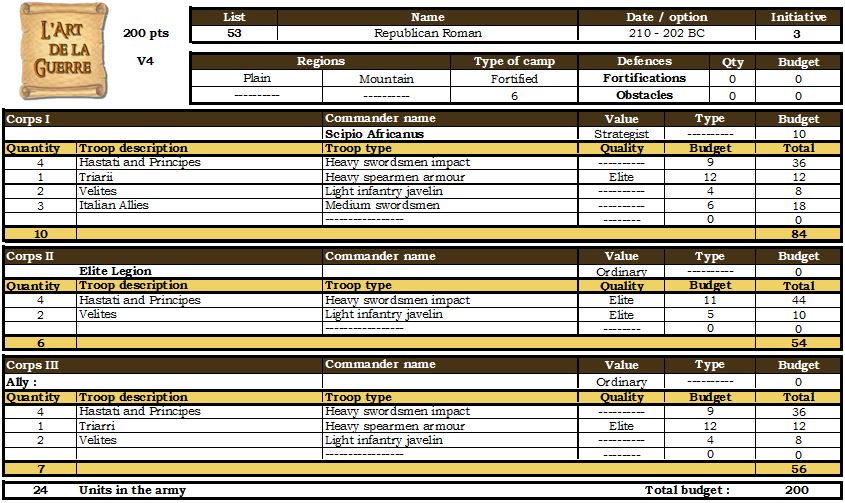
My last game with Romans I had experimented with no cavalry. I decided to continue the experiment, but to put all my medium infantry in the one corps. To control this mixed corps I decided on a strategist, which would also help with initiative and terrain relocation. By making my two remaining generals ordinary, I had enough points to have 3 medium swordsmen.
This gave me the C-in-C's corps with a full legion and 3 medium swordsmen, another corps with a full legion, and the final corps a slightly smaller veteran legion. The plan was to anchor the C-in-C's corps with medium infantry in rough terrain, and have the veteran legion in the middle of the army to ensure that it got into combat.
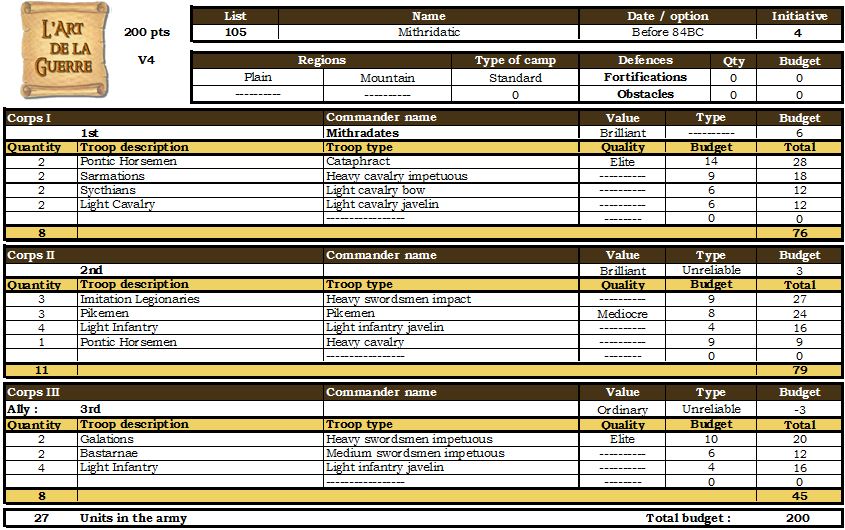
At the start of the game I found I was facing Mithridatic (list 105), which I had never seen before. A quick look at the army list and I guessed (wrongly) it would be a largely cavalry army with some supporting infantry.
Army lists
My Republican Roman list
Phillip's Mithridatic list was
The Game
I won initiative and decided to attack in the mountains, as this was most likely to hinder a cavalry army. I was unsuccessful in rolling a coastal zone. Phillip chose 2 steep hills, a woods and a gully. I chose brush, woods and an impassable lake.
We ended up with the majority of the terrain on Phillip's side of the battlefield, but with a wood in the centre of my deployment zone and a large empty space in the centre of the battlefield. I rolled to move the wood and got a 6, and moved it up towards the centre of the battlefield. I was thinking that this would hinder enemy horse. A terrible mistake, because it meant that it would end up splitting my battle line. What I should have done (expecting a cavalry opponent) was move it off to one side to anchor my flank, or (if I had correctly guessed what I was facing) remove it completely.
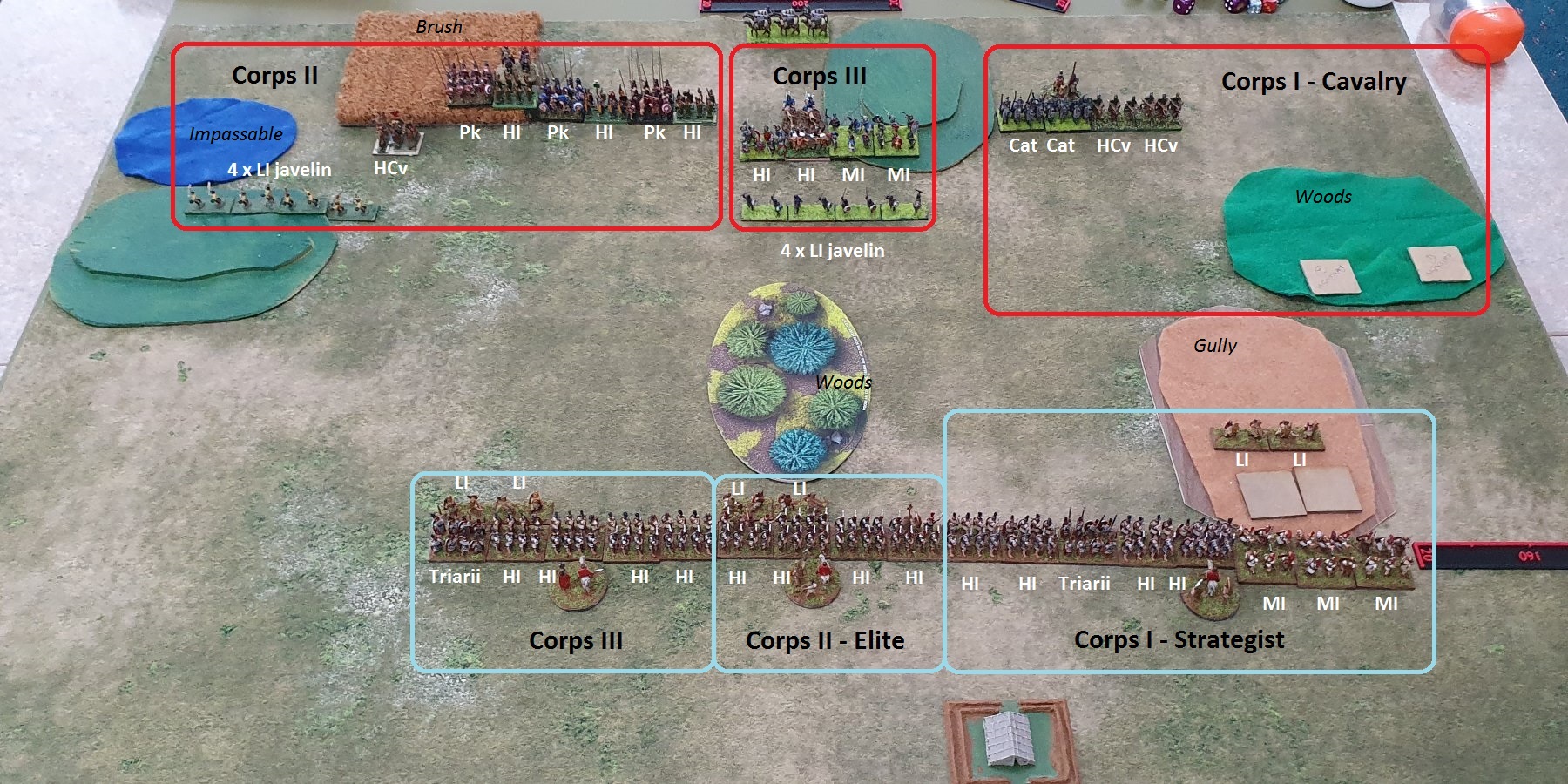
Initial deployment
When determining my deployment plan, I decided to anchor the right flank of my battle line on the gully. I had two dummy ambushes.
During deployment I didn't want to leave any gaps in my battleline and so I didn't leave room for my units to bypass the woods. In retrospect, deploying the Velites light infantry from the left and centre corps between the two corps and moving up through the woods would have made more sense.
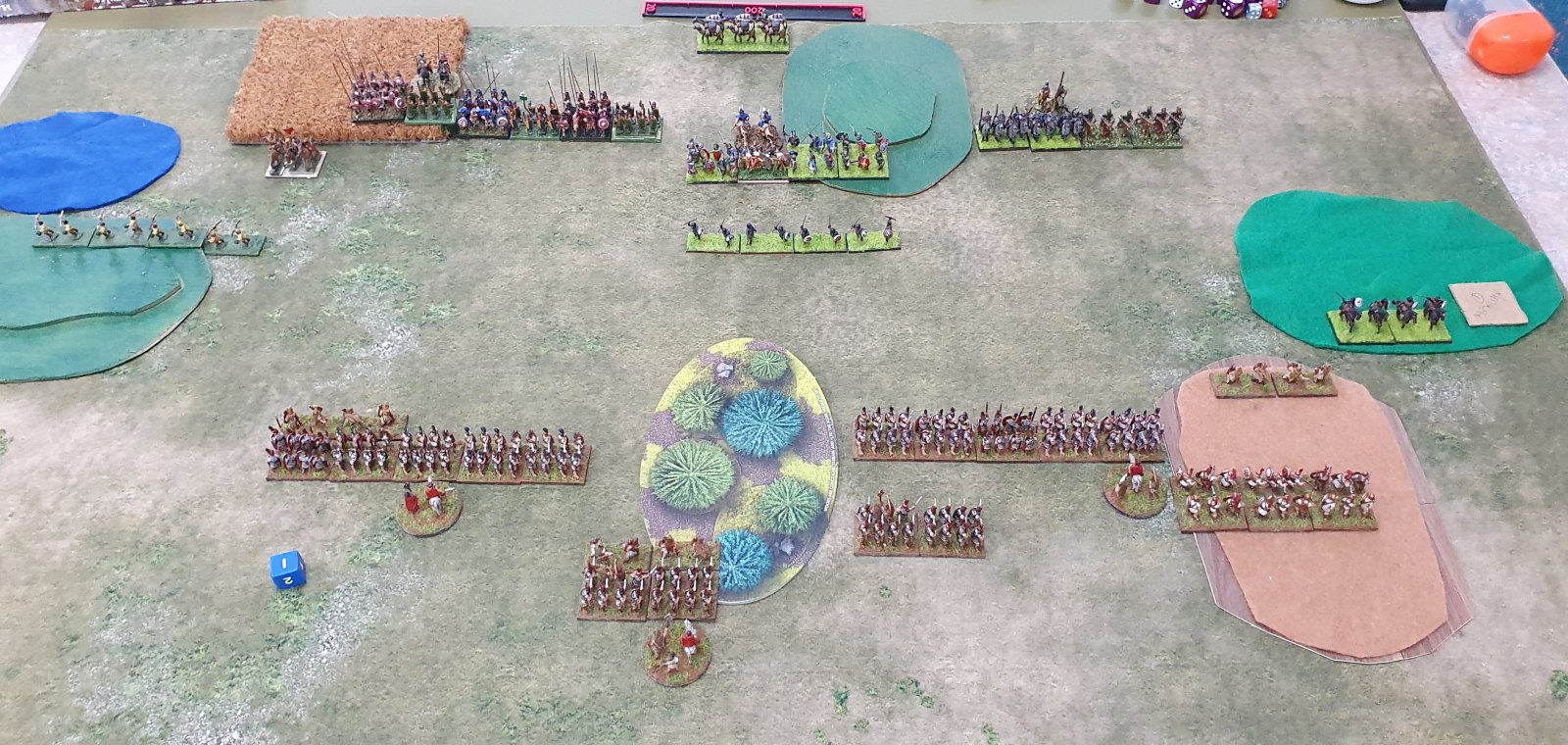
End of Roman Turn One movement
Roman turn one saw me move up as far as possible. The centre corps had to split in to two to move around the woods. Lack of command pips meant that I could not move my Velites light infantry separately through the woods as I would have preferred. The Velites on my right flank moved up through the gully to reveal two enemy light horse in ambush.
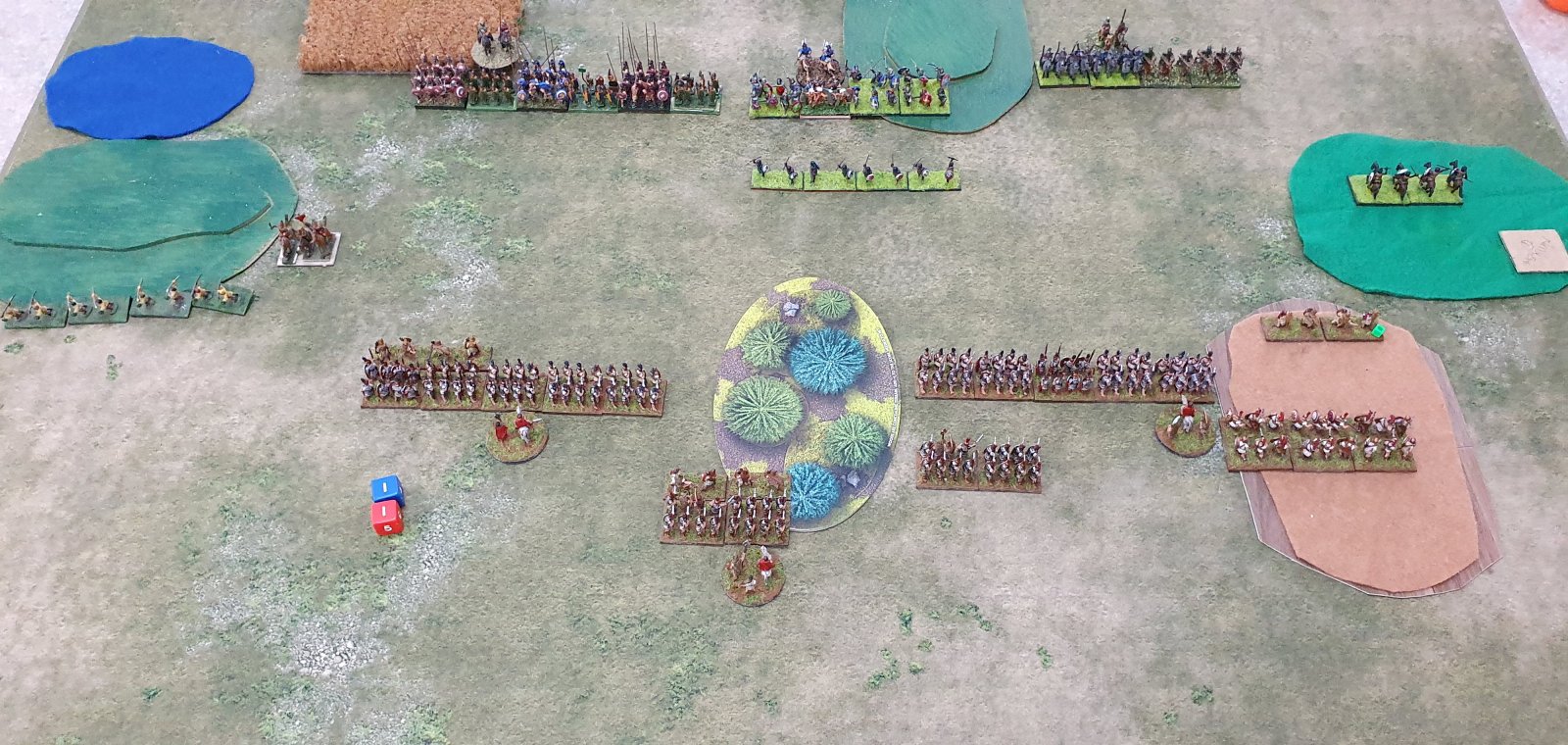
End of Mithridatic Turn One
Phillip moved up his light foot and Pontic heavy cavalry on his right flank our wide of my left flank. His central general rolled unreliable and stayed put. On his left flank he moved back his light horse.
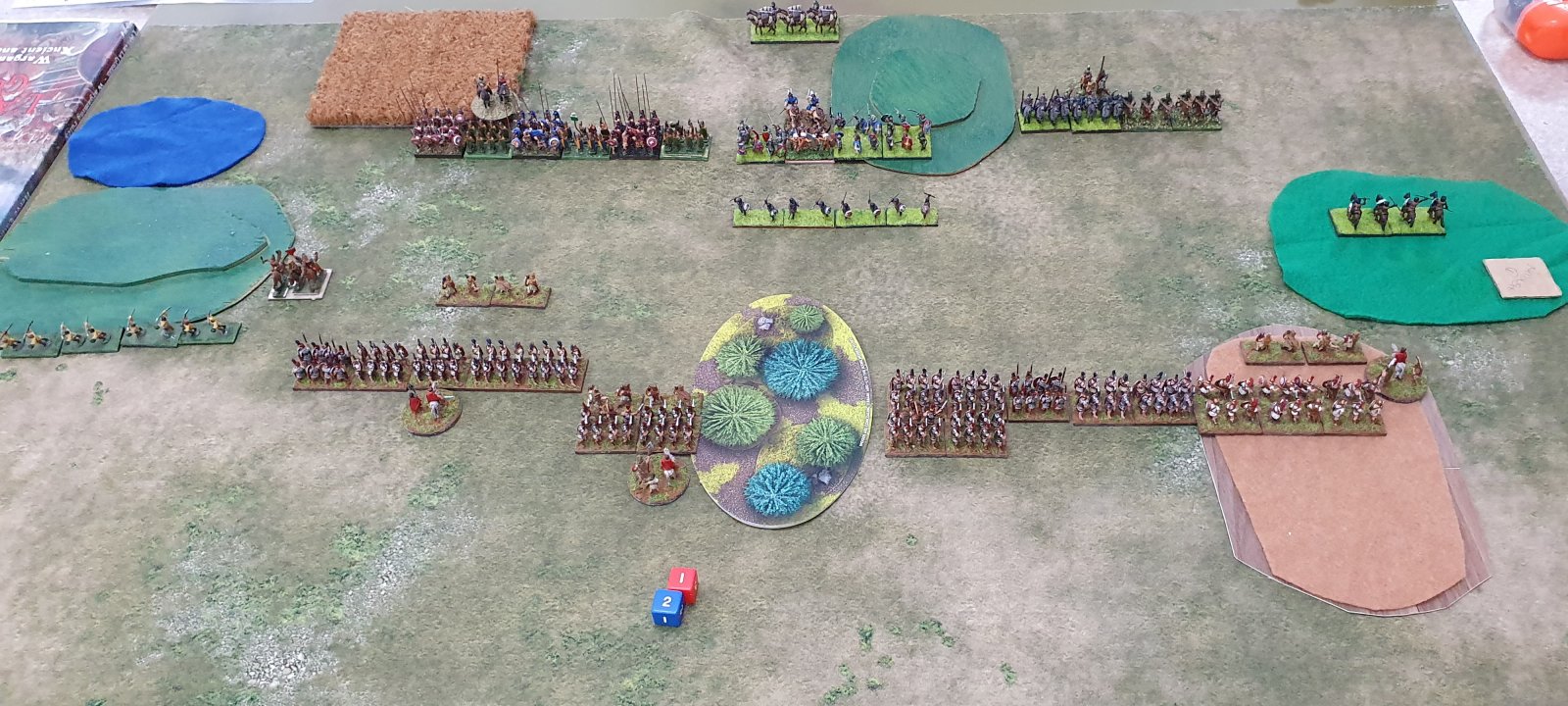
End of Roman Turn Two
On my left I pushed forward the light infantry. In the centre I continued to push forward my heavy infantry as much as I could. Once again lack of command pips restricted my options. On the right I moved up my medium swordsmen. I did not move forward my main battleline on the right because I didn't want to trigger his unreliable general in the centre.
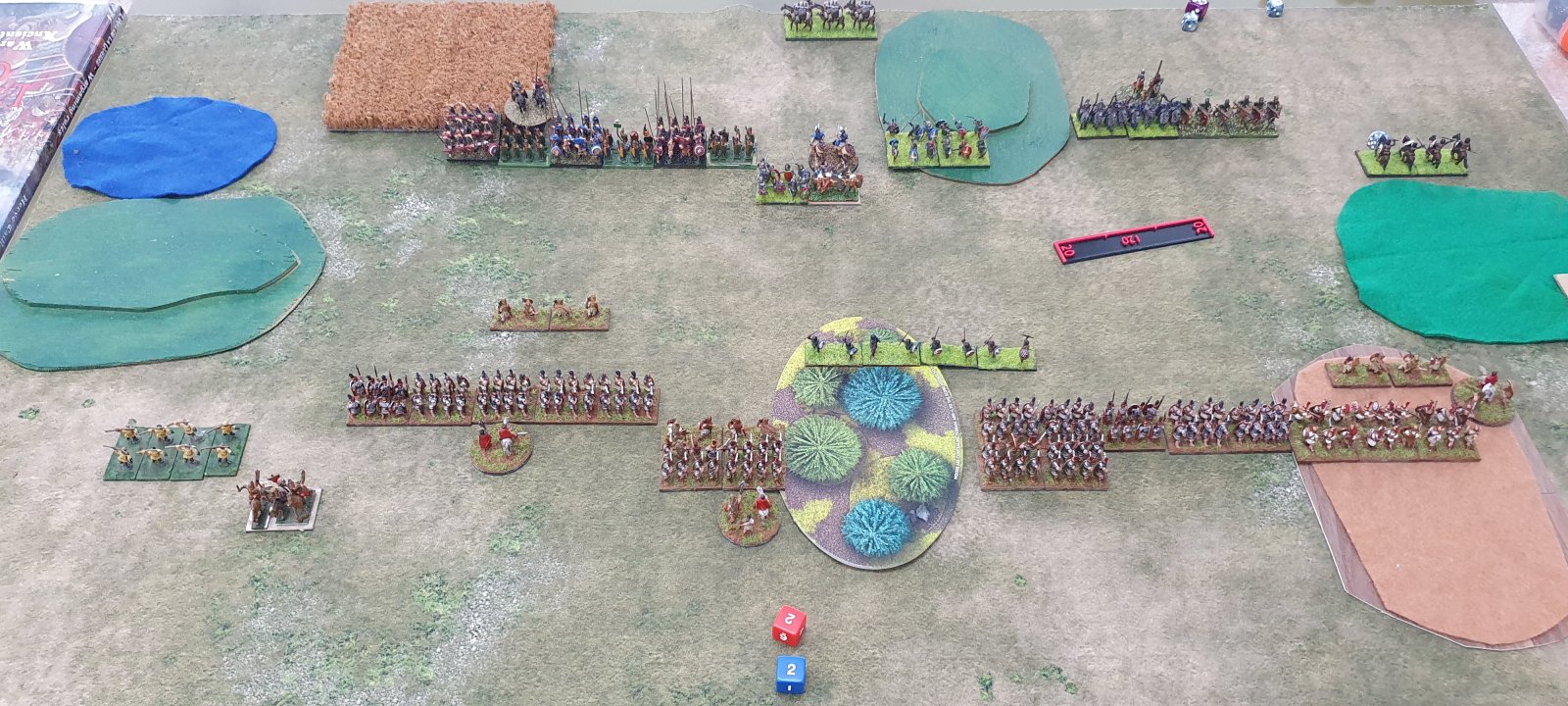
End of Mithridatic Turn Two
Phillip pushed his light infantry and single Pontic horseman past my left flank. On his other flank, his CinC spent two pips to help the centre general become reliable. He also pulled his light cavalry back out of the woods.
In the centre his general did not roll a 5 or 6 so as to become reliable. However we found that my light infantry was just within 4UD of his skirmish screen and so the command went active anyway. He moved up his light infantry into the wood and started pushing forward his Galation heavy swordsmen.
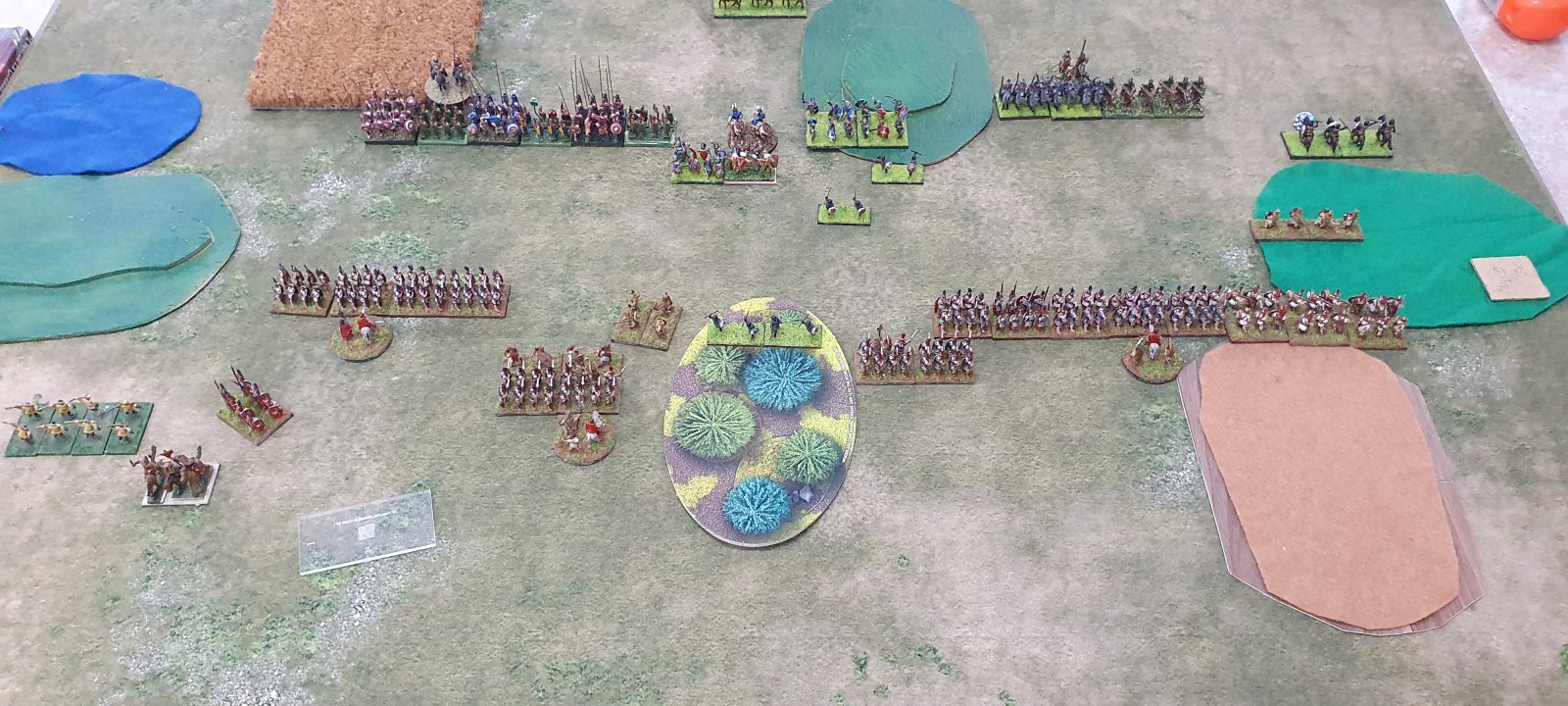
End of Roman Turn Three
In turn three, I felt that it was time to try and get the Roman heavy infantry moving up to get into combat. On my left flank I had to peel off the Triarii to turn back and cover my flank from the Pontic heavy cavalry. The heavy infantry moved forwards and the light infantry moved back towards the woods. On my right flank everyone moved forward.
My centre corps was once again hit by lack of command pips. I wanted to move both pairs of legionaries up, so I didn't have the command pips left to detach my light infantry to assist in the battle in the woods. However the right pair of legionaries did charge forward and cause two of the Mithridatic light infantry to flee.
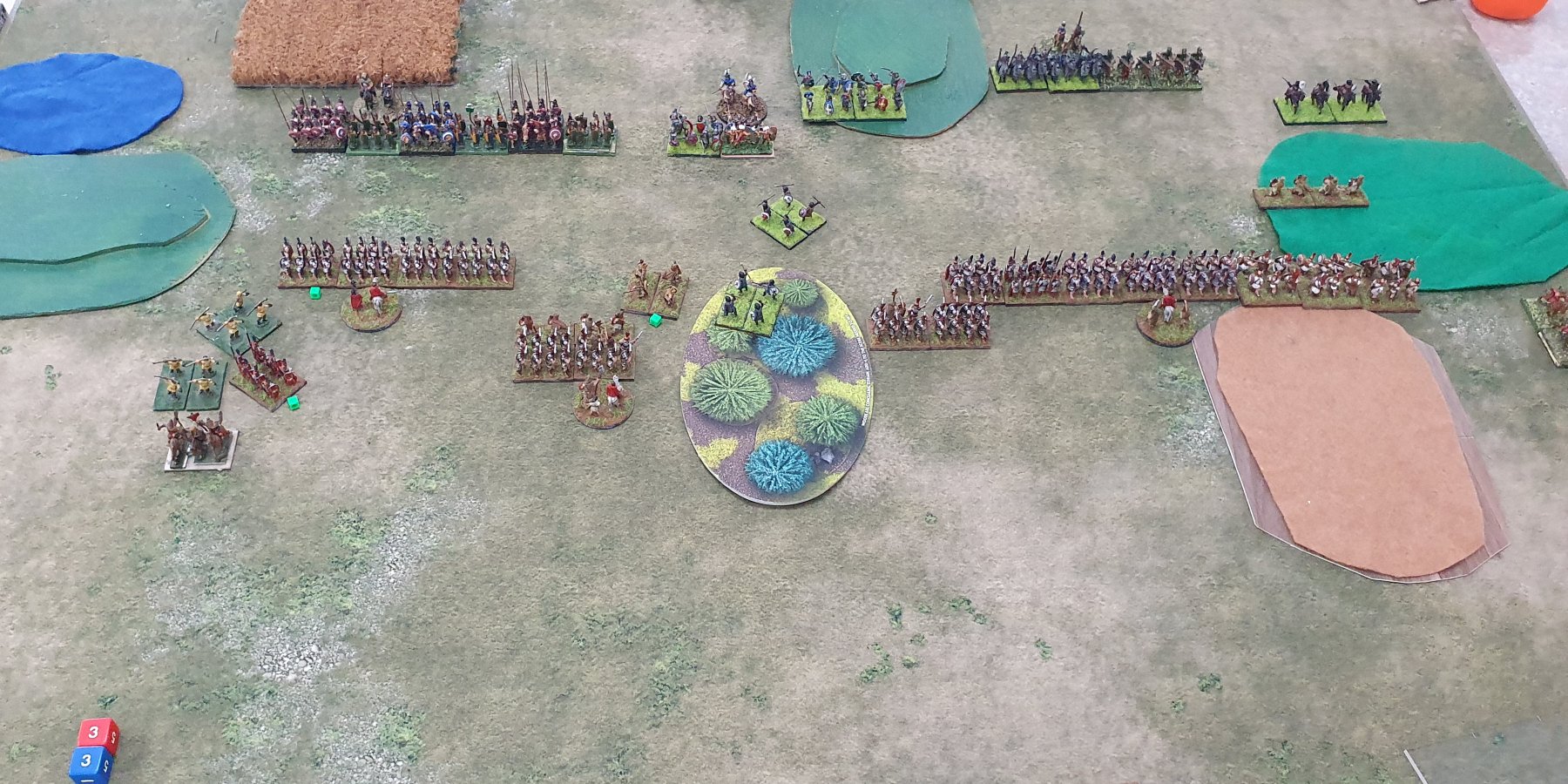
End of Mithridatic Turn Three
In Phillip's turn three, the Mithridatic phalanx started moving forward. His skirmishers moved up to shoot at the Romans, and three separate lots of shooting resulted in 3 hits. His centre corps just moved his light infantry forward, whilst on his left flank he revealed the remaining ambush as containing two Sycthian horse archers, which he moved behind my right flank. The heavy cavalry and cataphracts stayed put.
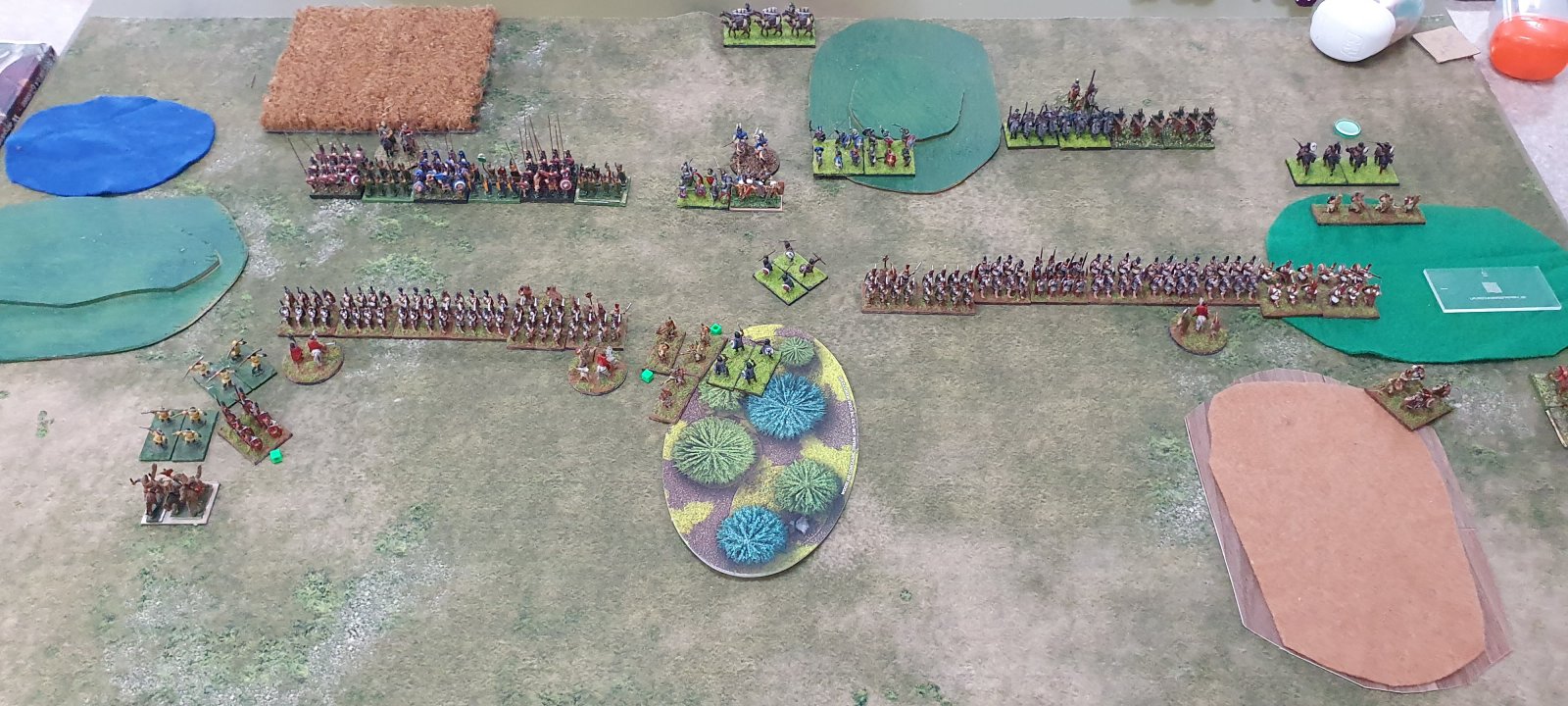
End of Roman Turn Four
On my left flank my battle line moved forward. The uninjured light infantry from this command charged though their fellow light infantry into the enemy skirmishers in the wood.
On the right flank, my battle line moved forward except for one unit of medium swordsmen that peeled off to cover the enemy light horse bowmen. The Velites light infantry moved up to exchange shooting with the enemy light horse with javelins just behind the wood.
In the centre I had enough command pips to move each pair of legionaries forward to meet up with the battle lines (both just short of lining up), and also moved a unit of Velites to support my light infantry in the woods.
In the shooting, my Velites on the right flank did a hit on the enemy light horse. In the combat in the woods, my Velites took a hit.
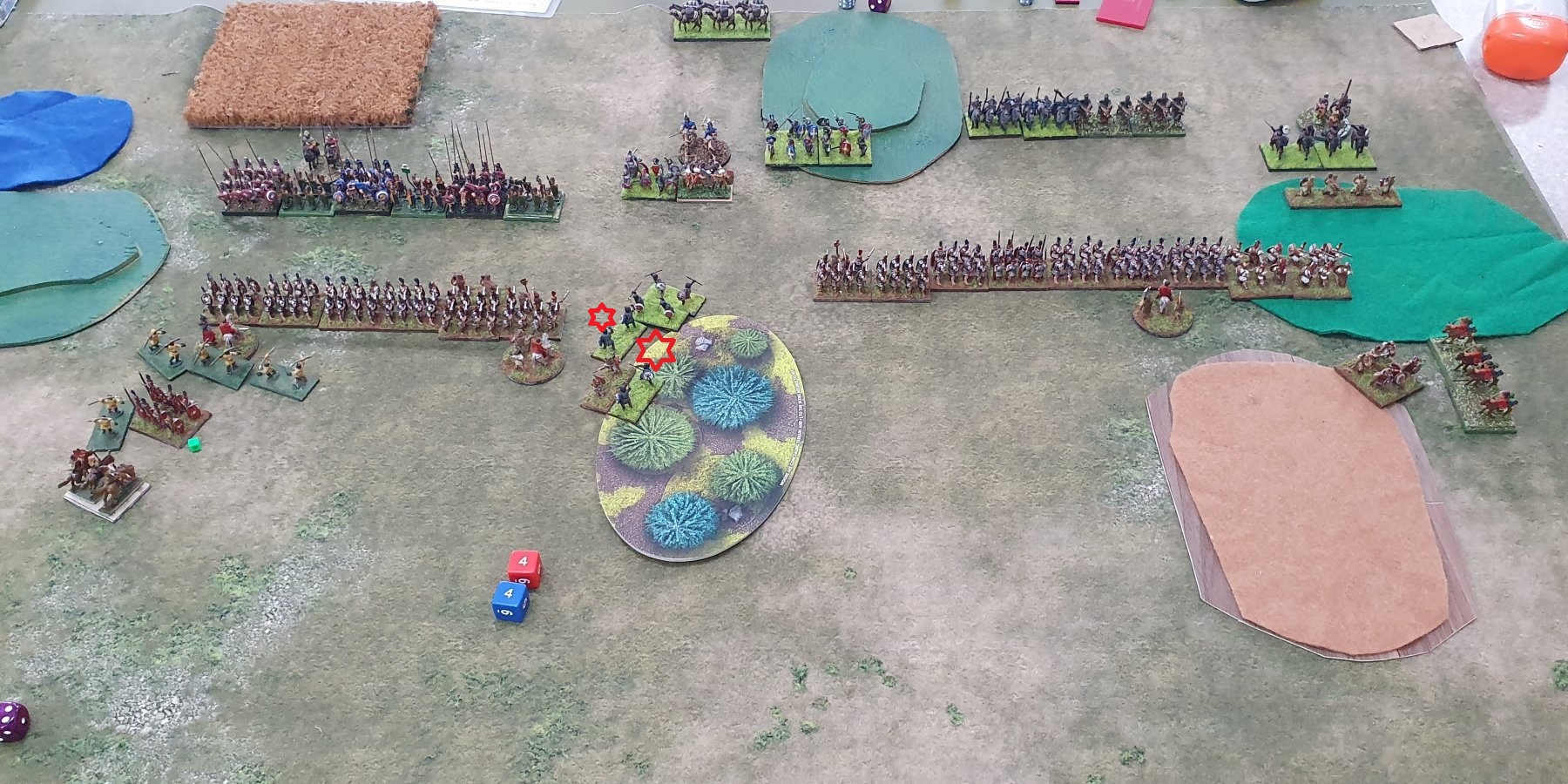
End of Mithridatic Turn Four
On his right flank, Phillip moved his light infantry to threaten the rear of my battleline. No hits were stored during the shooting phase. His centre light infantry moved to join in the battle in the woods. On his left flank he moved his general to his light horse to rally off his hit from shooting, and moved his light horse bow to threaten and ZOC my medium swordsmen.
In the light infantry melee in the woods, my Velites were routed and they routed through the disrupted unit of Velites behind them, who then routed themselves. The Mithridatic light infantry performed a pursuit.
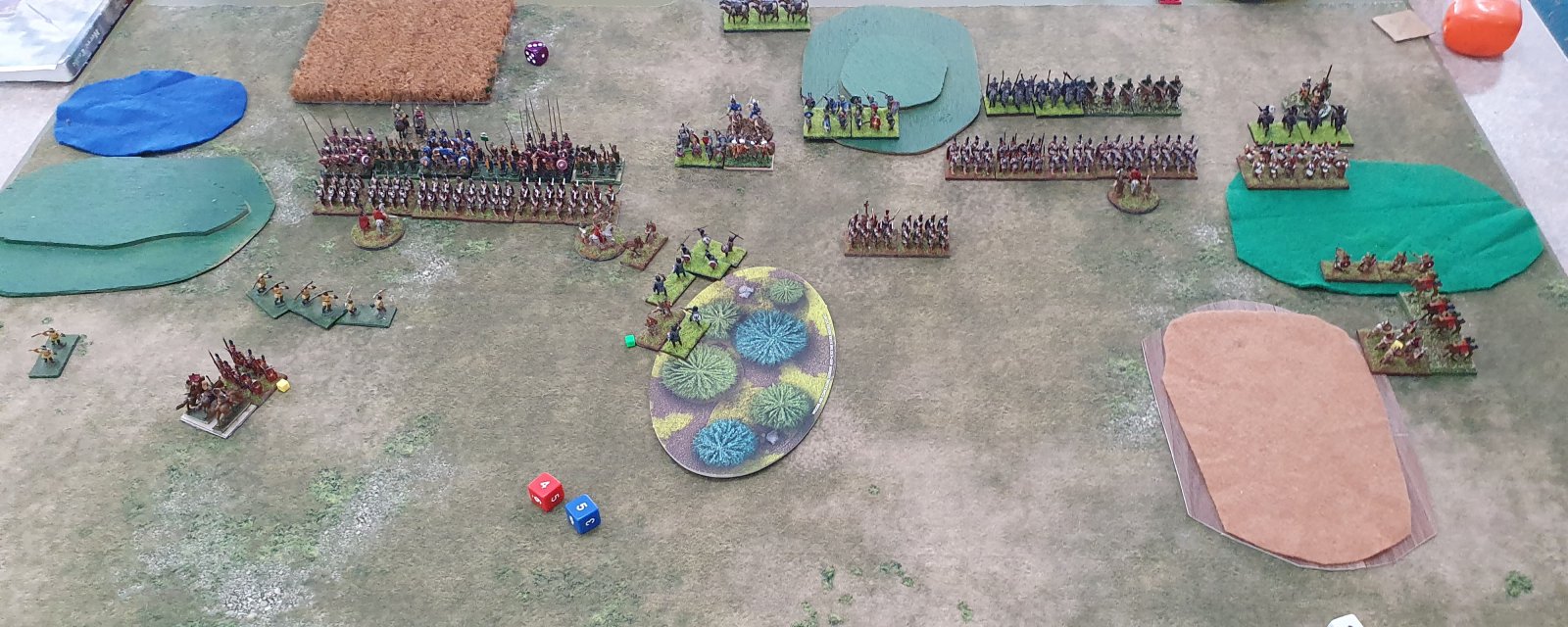
End of Roman Turn Five
On my left flank the Triarii charged forwards causing the enemy light foot to flee and continued on to charge into the heavy cavalry. The battle line on the left advanced as far as they could and ended up just short of the enemy phalanx. In the centre the left pair of legionaries units moved up to this battle line, and the remaining screening Velites unit moved back to screen the flank and rear of the units by ZOCing the enemy light infantry.
My remaining two legionaries units from the centre corps were out of command range from their general and so I did not have the command pips to move them.
On my right flank I moved the heavy infantry up to threaten the cataphracts and heavy cavalry, move the medium infantry up to close to the light horse beyond the woods, and charged in with my medium swordsmen into the Scythian light horse bow. I also moved back the light infantry to threaten the flanks of the Scythian light horse.
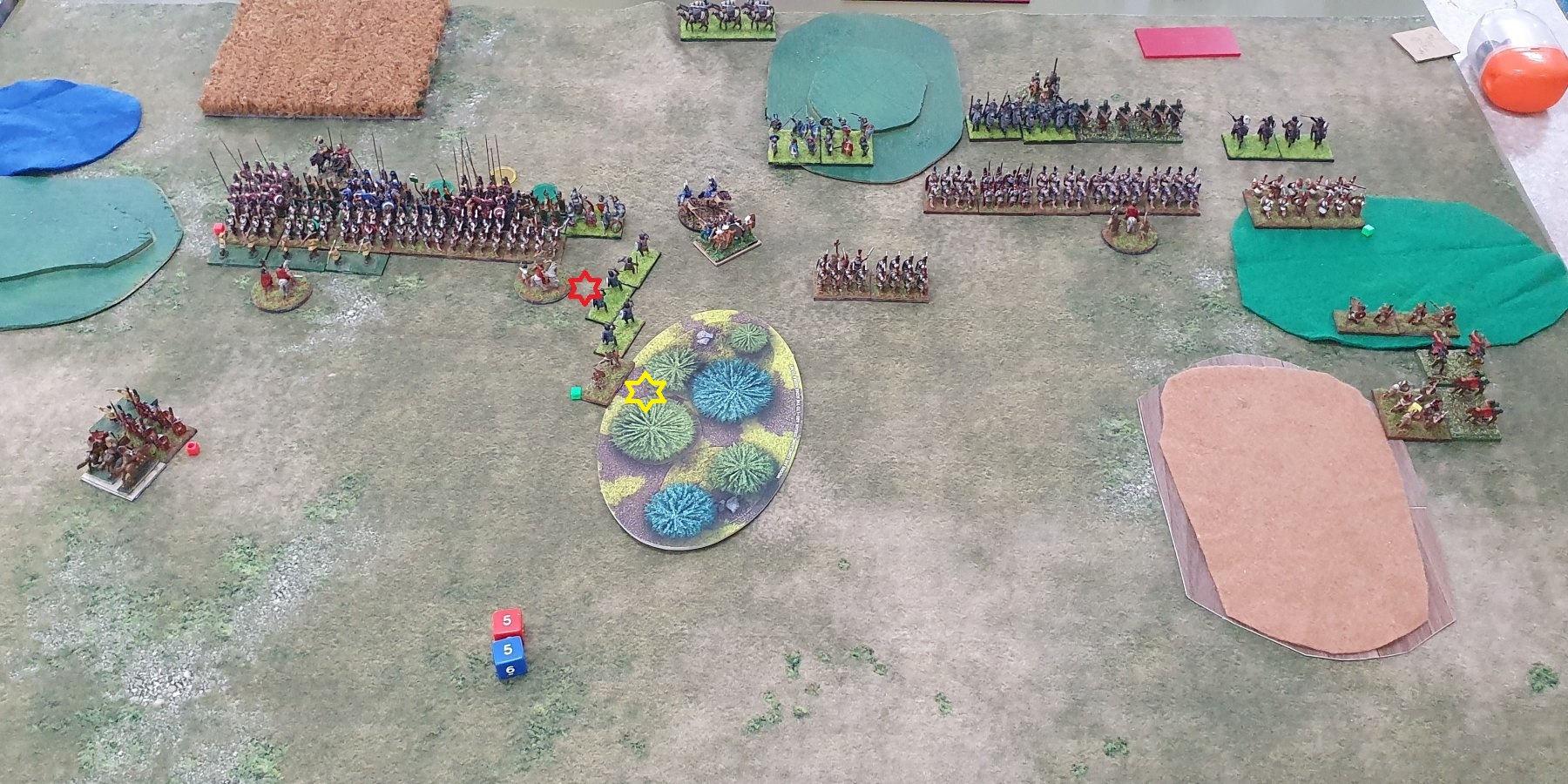
End of Mithridatic Turn Five
On my left flank, Phillip charged his phalanx into my battleline with support by one of his Galations heavy infantry units. His light infantry charged into the rear on my three leftmost legionaries. This didn't cause a cohesion hit (because they are light infantry) but did remove my Impact ability (p63) as well as giving his units +1 for rear support.
In the resulting melee the three legionaries units that were attacked in the rear lost 3 wounds, lost 1 wound and drew. The remaining 3 legionaries units inflicted 1 wound, inflicted 2 wounds and inflicted 1 wound. This demonstrated the value of his light infantry support.
On the far left his light infantry came back to provide support in the cavalry vs Triarii melee. In the centre, my screening unit of Velites light infantry were charged and routed in the melee. In the woods, the elite Velites routed their opponents.
The Mithridatic left flank cataphracts and heavy cavalry stayed put, but his light horse javelin moved back a little further from the woods. They inflicted one hit by shooting on my medium swordsmen. On the near side of the woods, one of the light horse bow turned to face my Velites light infantry.
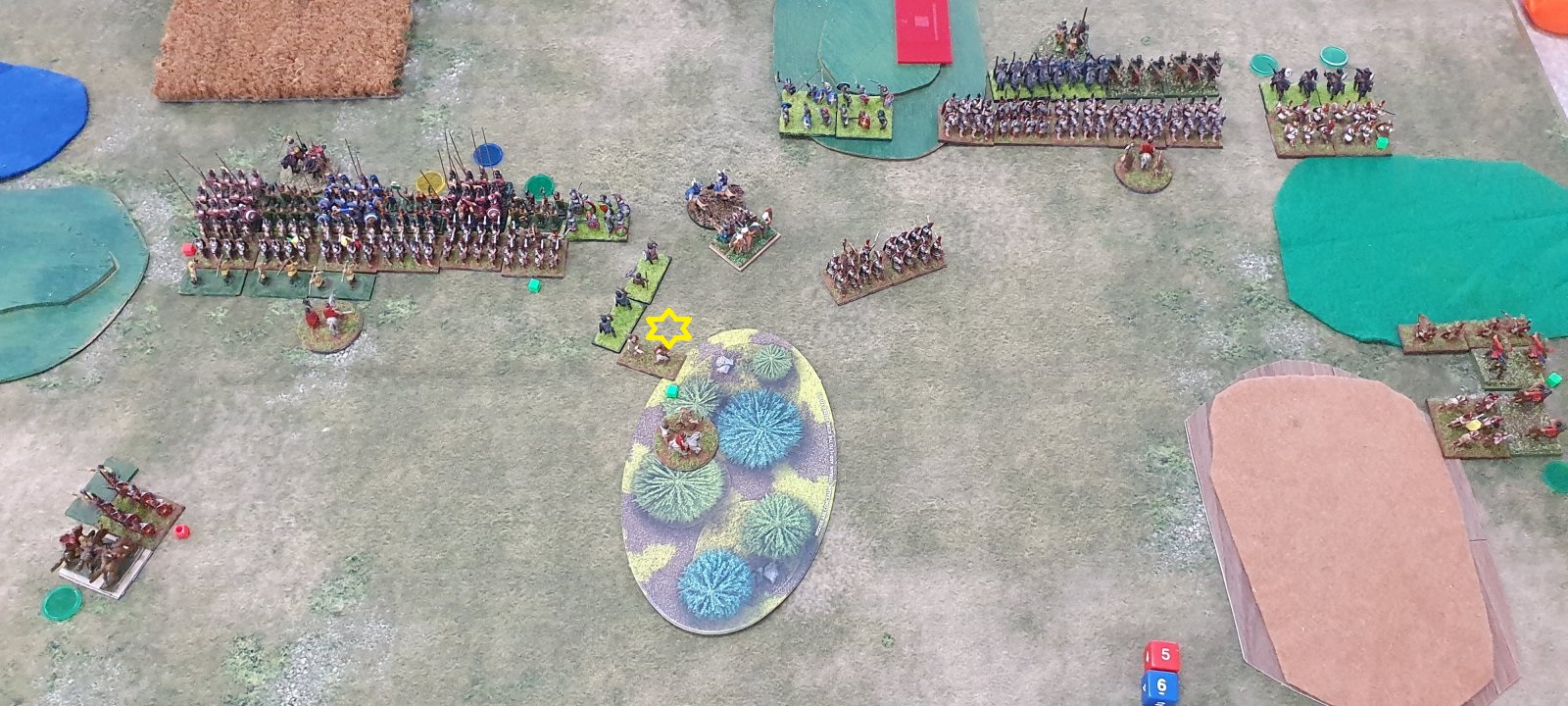
End of Roman Turn Six
Not much movement on my left flank, with the various melees continuing. In the centre my general rolled high for command pips. This let me move my general into command range for the right hand pair of legionaries, which wheeled to face the threat of both the Galation heavy swordsmen and the Bastarnae medium swordsmen on the hill. They were constrained in their movement as the left unit was just ZOCed by the Galations. The Velites charged an unit of enemy light infantry in the flank and routed it.
On the right flank I moved my battle line to just short of the enemy cavalry. My pair of medium swordsmen units charged the light cavalry javelin. Although they were disadvantaged in not having cleared the woods, they both won their melees. My Velites light infantry charged from the woods on the right flank into the light cavalry bow.
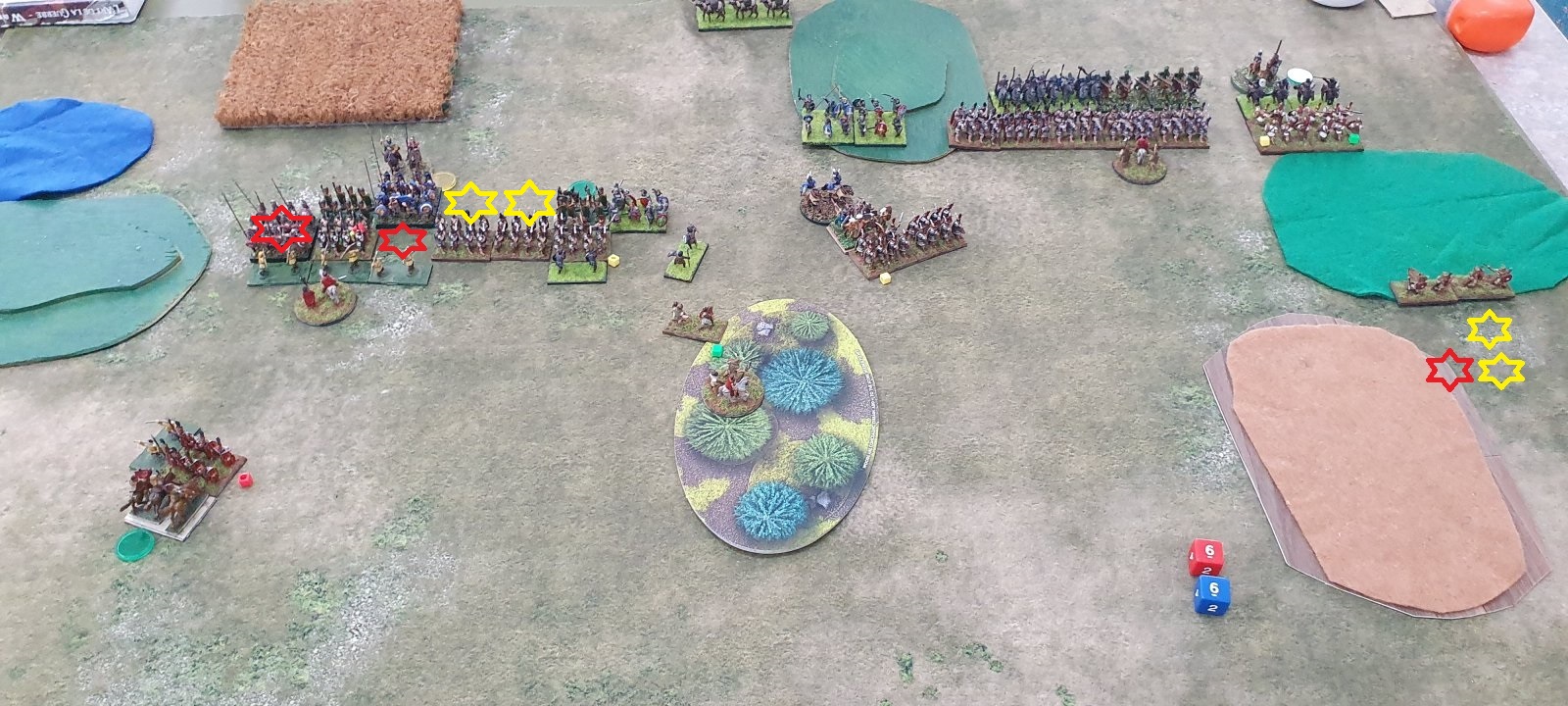
End of Mithridatic Turn Six
In the Mithridatic turn six, the centre light infantry moved to support the pike phalanx and the unit of Galations charged my pair of elite legionaries.
In the melee on my left flank, units were routing on both sides. Two units of legionaries which had been fighting to both front and rear finally routed. However the legionaries who were only fighting to their front routed two Mithridatic units of heavy foot.
On the right flank my single unit of medium cavalry was routed by the light horse bow. However my light infantry routed their opposing light horse bow, which fled through the victorious light horse bow unit and caused it to route in turn.
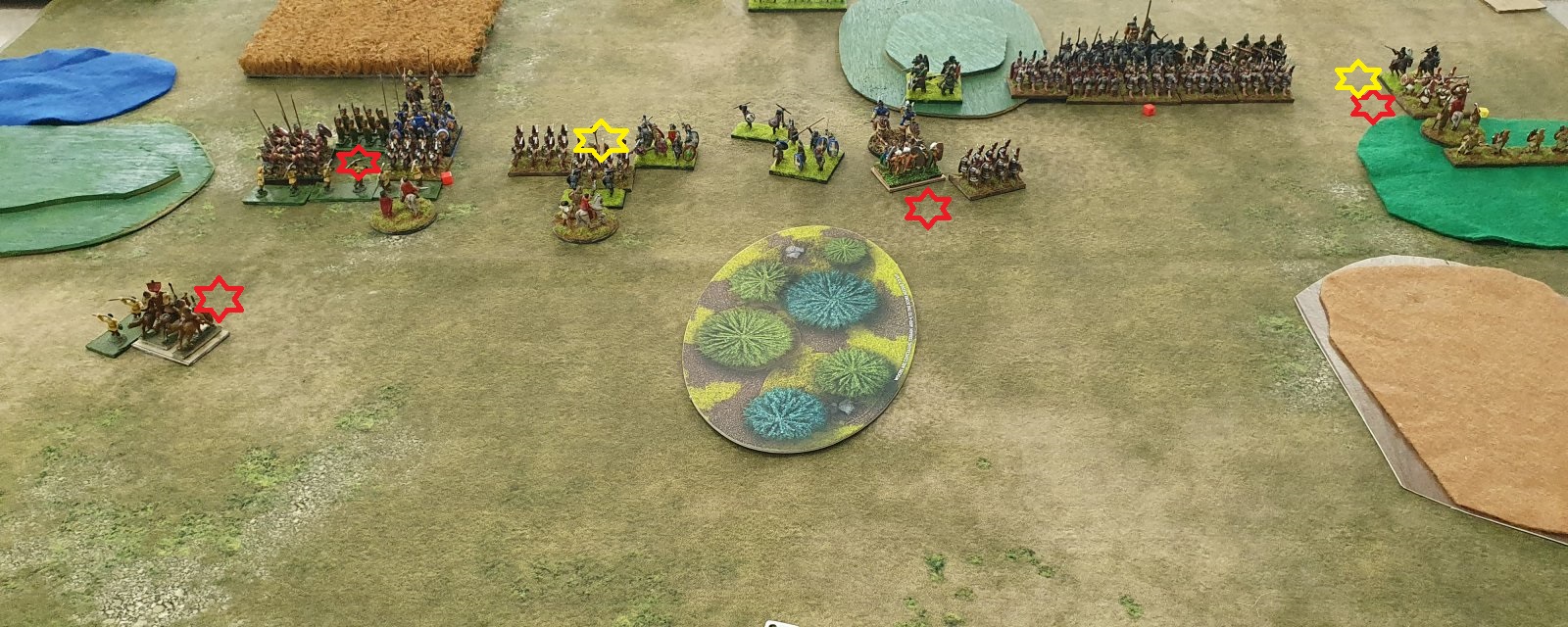
End of Roman Turn Eight
Not much movement by either side in turn seven as nearly everything was engaged in combat already. In the battle on the left flank, the unengaged legionaries conformed to fight the pikes. On the right flank the battle between the medium infantry and the light horse, one unit from each side routed and the remaining unit conformed to continue the melee.
On the start of turn eight my army was on the verge of breaking. I thus decided to charge the battleline on my right flank into the cataphracts and heavy cavalry to try and inflict some more losses on the Mithridatic army. We resolved the other combats first, and my army would have broken if I hadn't charged in. One of my units took hits, but I think that I caused a couple of hits on his horse.
The game ended up in the Roman turn 8. The cohesion losses in the last four player turns were:
Roman 6 - Mithridatic 6: Roman cohesion losses 19/24, Mithridatic 16/27
Roman 7 - Mithridatic 6: Roman cohesion losses 22/24, Roman 17/27
Roman 7 - Mithridatic 7: Roman cohesion losses 23/24, Roman 18/27
Roman 8 - Mithridatic 7: Roman cohesion losses 25/24, Roman 21/27
I had made some blunders in the game, mainly around the woods in the centre of my deployment zone. However I was satisfied with taking the battle into the opposing half of the battlefield, getting all my units into melee, and doing a reasonable amount of damage on the enemy army.
Lessons learnt
The second mistake was in my deployment and having heavy infantry just behind the woods. It was only my last battle report (and last game) when I wrote "moving up heavy infantry close to and then into terrain was a foolish mistake that I have hopefully learned from". I obviously failed to learn the lesson and so had to have it repeated. Hopefully the lesson sticks now.
What I should have done is deploy my heavy infantry each side of the woods, potentially with my light foot in-between to keep my battle line. However this would have meant my right flank would have been cramped.
Phillips use of his light infantry to support his pike phalanx was masterful. In the first round of combat my units were disadvantaged by two (loss of impact, and enemy in the rear). No wonder that these three units eventually routed, although it took 3 rounds of melee which shows the robustness of the heavy infantry.
I was very surprised that Phillip held back his cataphracts and impetuous heavy cavalry, which didn't move all game. His comment was that he didn't need to. As it was, his 46 points of cavalry tied up my 48 pts of infantry so it a fairly even portion of our armies tied up. Given the result when I charged in, and if he had charged me instead I would have had impact, it looks like he made the right decision.
Phillip has advised me before that you don't need to get units into combat. Just the threat they pose can mean that they are serving their purpose. I guess this is what his cavalry was doing.
In terms of my army composition because I split up my elite corps I had real problems with command and control. Not just not having enough command pips to do what I wanted, but in one turn having half my fighting units out of command range.
Phillip suggested that 3 medium infantry is too many, and that two would have been enough. Also that light infantry is more useful in difficult terrain than medium infantry.
I will need to reflect if I needed more light infantry, or just needed to use them more effectively. I ended up with using 4 light infantry in the centre woods, but came out second best against his 4 light infantry in the centre. That might have just been a matter of bad dice rolls, but having the left corps light infantry operating in the woods in the centre meant that my left flank was unguarded. It might have been better to fight a delaying action in the centre with only two units and protect my left flank.
In terms of guarding my left flank, Phillip suggested that a unit of medium or heavy cavalry might have been useful to threaten the flanking heavy cavalry and four light infantry.
Phillip's Comments