This was my first game after a 4 month COVID lockdown. It was also my first game of v4 of ADLG.
I was excited to be using a variant of my army I hadn't used before, against a historical opponent army, which was an army I hadn't faced before, and an opponent I hadn't played before. I was also getting to use new models that I had painted over the last few months.
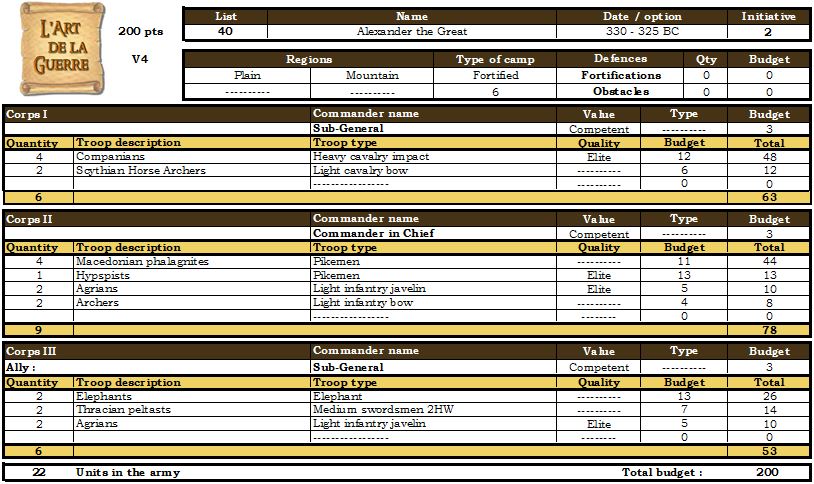
In terms of the army composition, I had a cavalry command based around the maximum number of Companions, an elephant command with the maximum number of elephants, and a pike command. By the time I added the light troops I didn't have many points left for commanders. To keep things simple for me after a long break from gaming I made all three generals the same level, competent.
My Alexandrian the Great list
Phillip won initiative (after a reroll as we both rolled "six" initially) and decided to attack in the mountains. In addition to the compulsory (brush covered) steep hills I took another brush covered steep hills and brush. Phillip chose an impassable lake, brush, gully and another steep hill. However he was unable to place his steep hill because it couldn't fit without overlapping (even on the re-roll). We both failed to adjust any terrain.
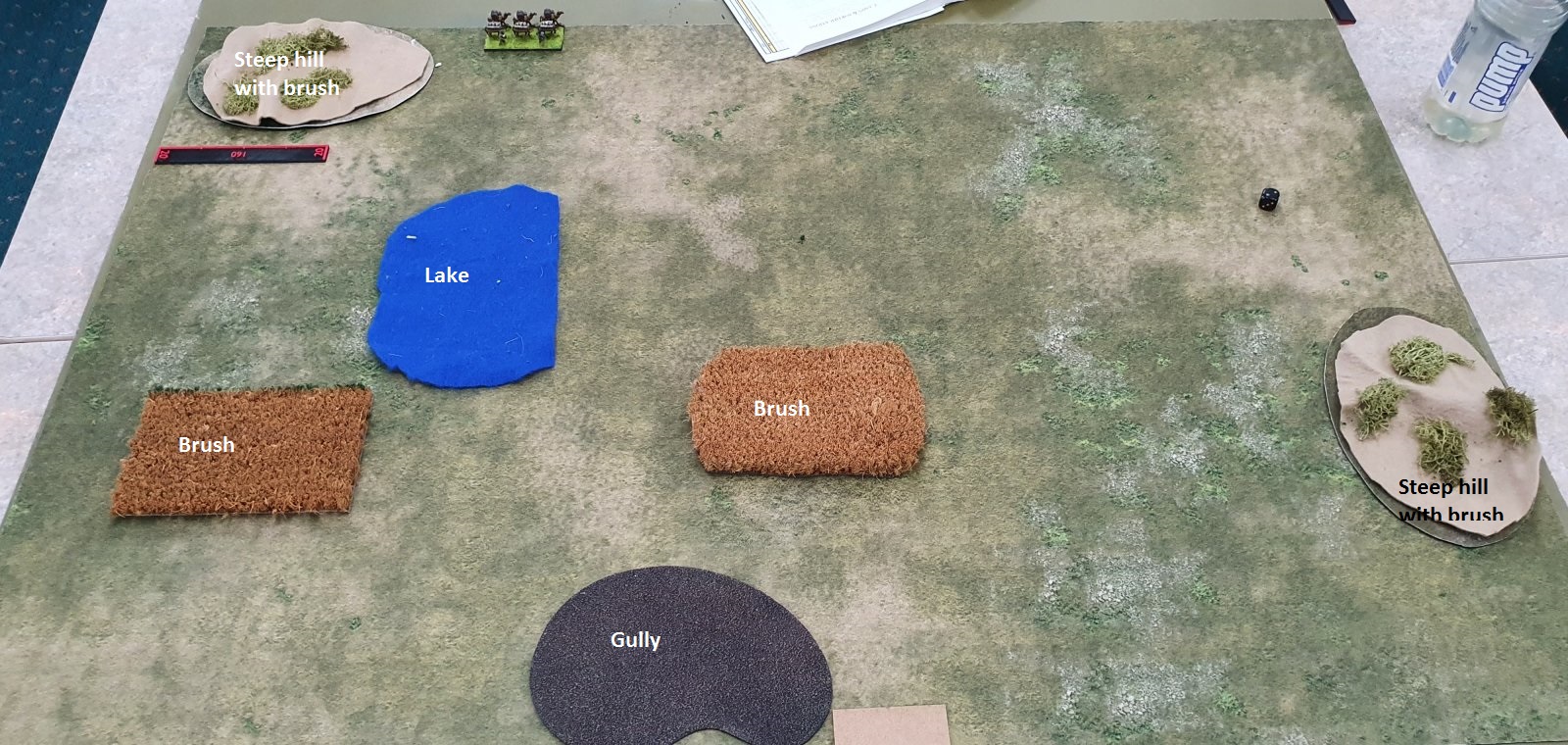
Final terrain placement
Note that I forgot to bring my model for the camp, so just used a 2UD x1UD base.
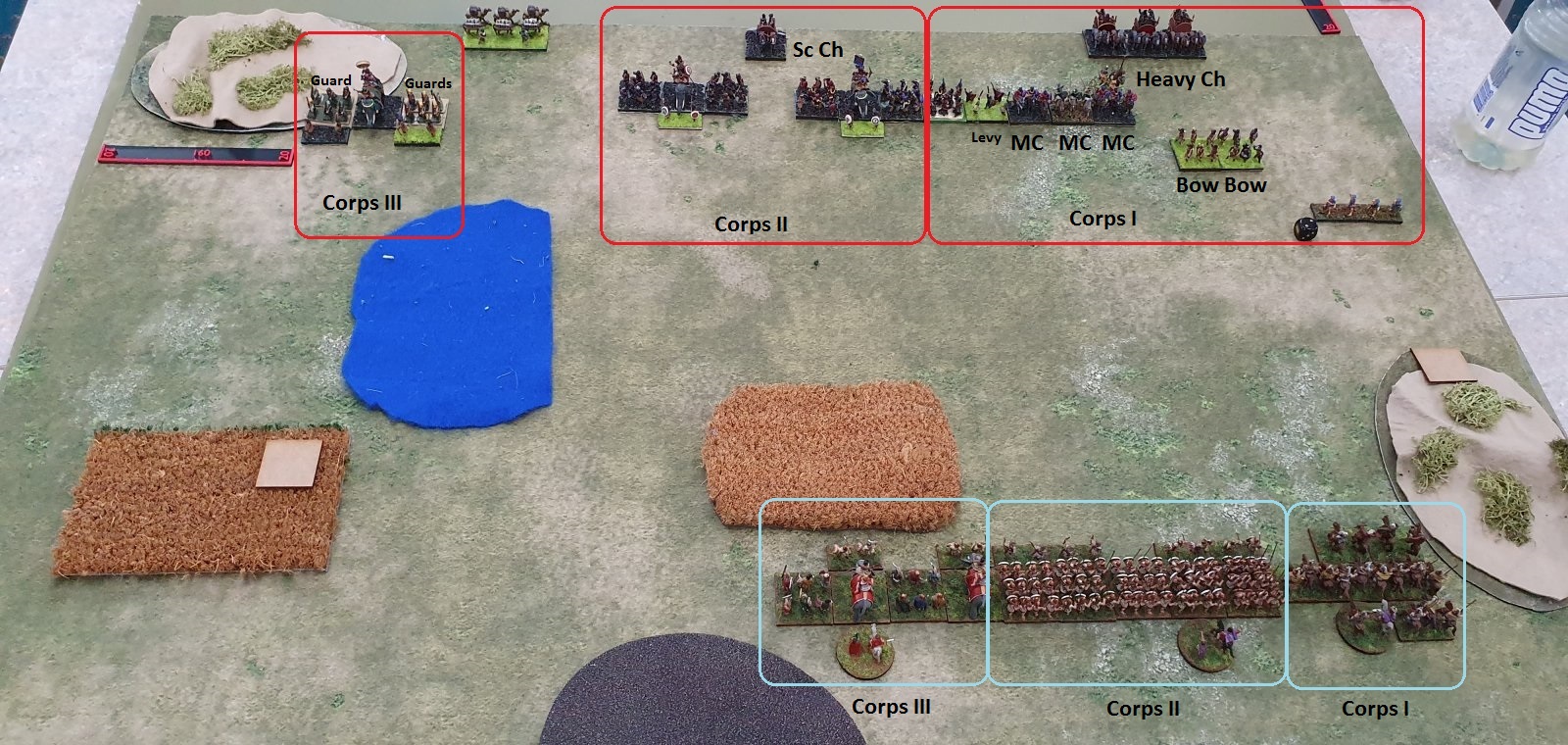
Initial deployment
I put down two dummy ambushes. With the rough ground ahead of the centre of my deployment zone I had to decide on whether I would have my pikes move through it, if I would split my deployment, or have it crowded to the right flank. I decided to have the elephant command (Corps III) go through the rough ground, the pikes to be adjacent, and my cavalry on the right flank.
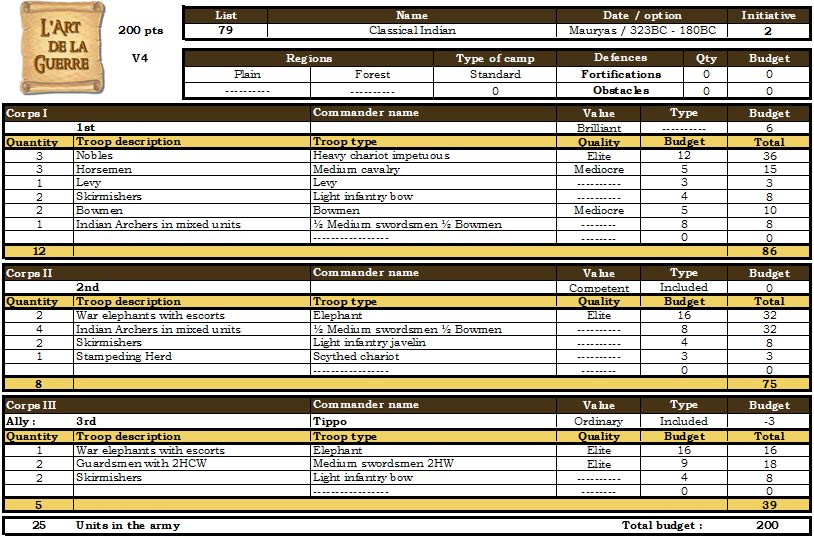
My first placement was Corps III, with the MI on the exposed flank for manoeuvrability. Phillip responded with his Corps II, two groups each consisting of one elephant with two mixed sword/bow and a skirmisher, with a gap between the two groups for the Scythed Chariot.
My second placement was Corps II with the Hypaspists on the right flank for a bit of extra robustness if the Companions moved off and left it exposed. Phillip responded with his Corps I, with the mixed sword/bow and levy meeting up with an elephant group from his Corps II. His mediocre Medium Cavalry was also part of that battle line, while his Heavy Chariots were right on his back board edge. He had mediocre bow towards his flank and two LI bow pushed forward on the flank.
My final placement was the cavalry Corps, and despite pre-measuring I still managed to end up with the unit running out of space with one Companion HC trailing behind the others. Phillip's final command was an elephant group with two elite MI 2HW guardsmen.
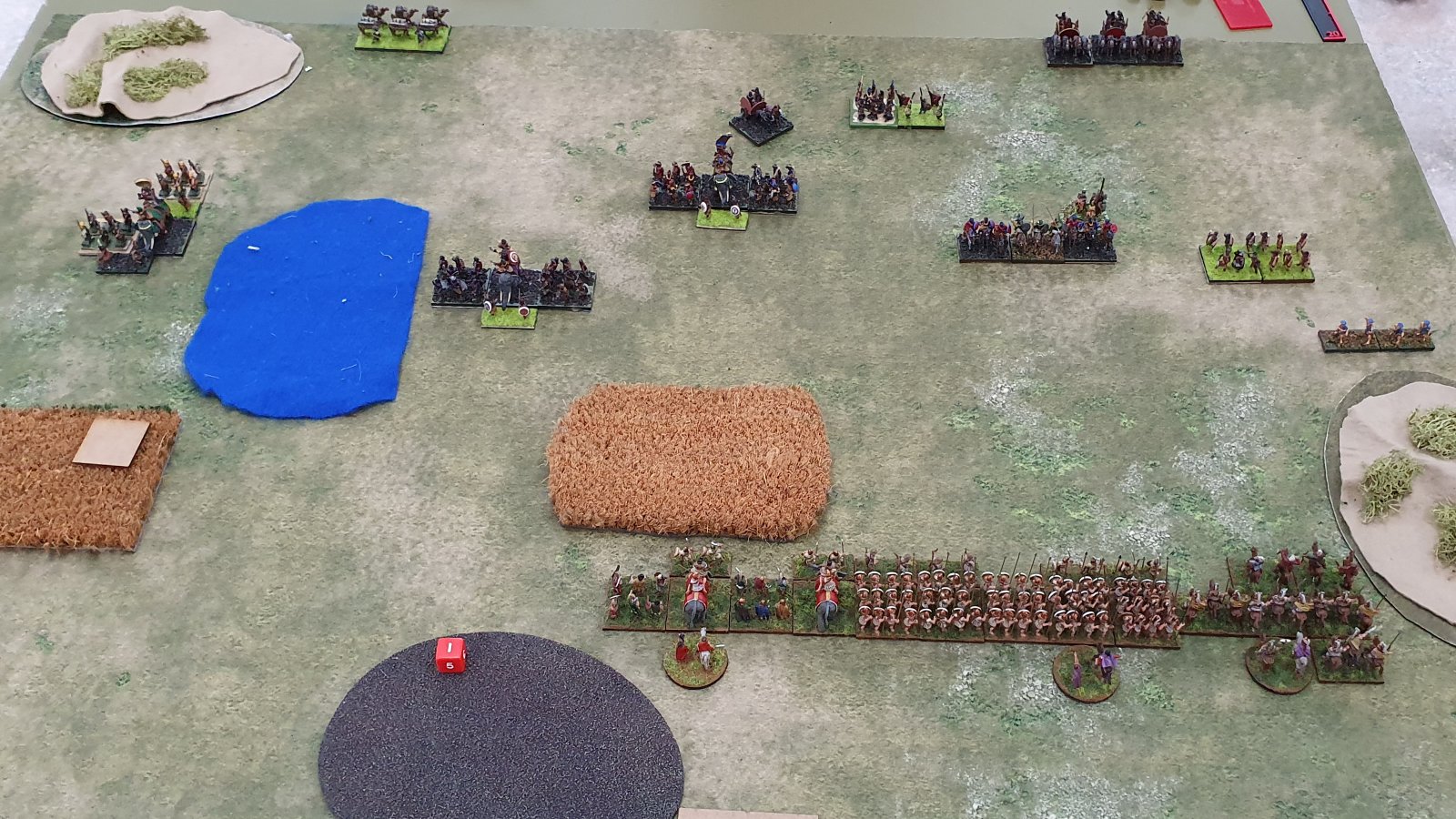
End of Indian Turn One
In Phillip's first turn the Indian group on my left flank did a double move, as did the (my) left group his central command. On my right flank he moved his medium cavalry, archers and skirmishers up but left his other units behind.
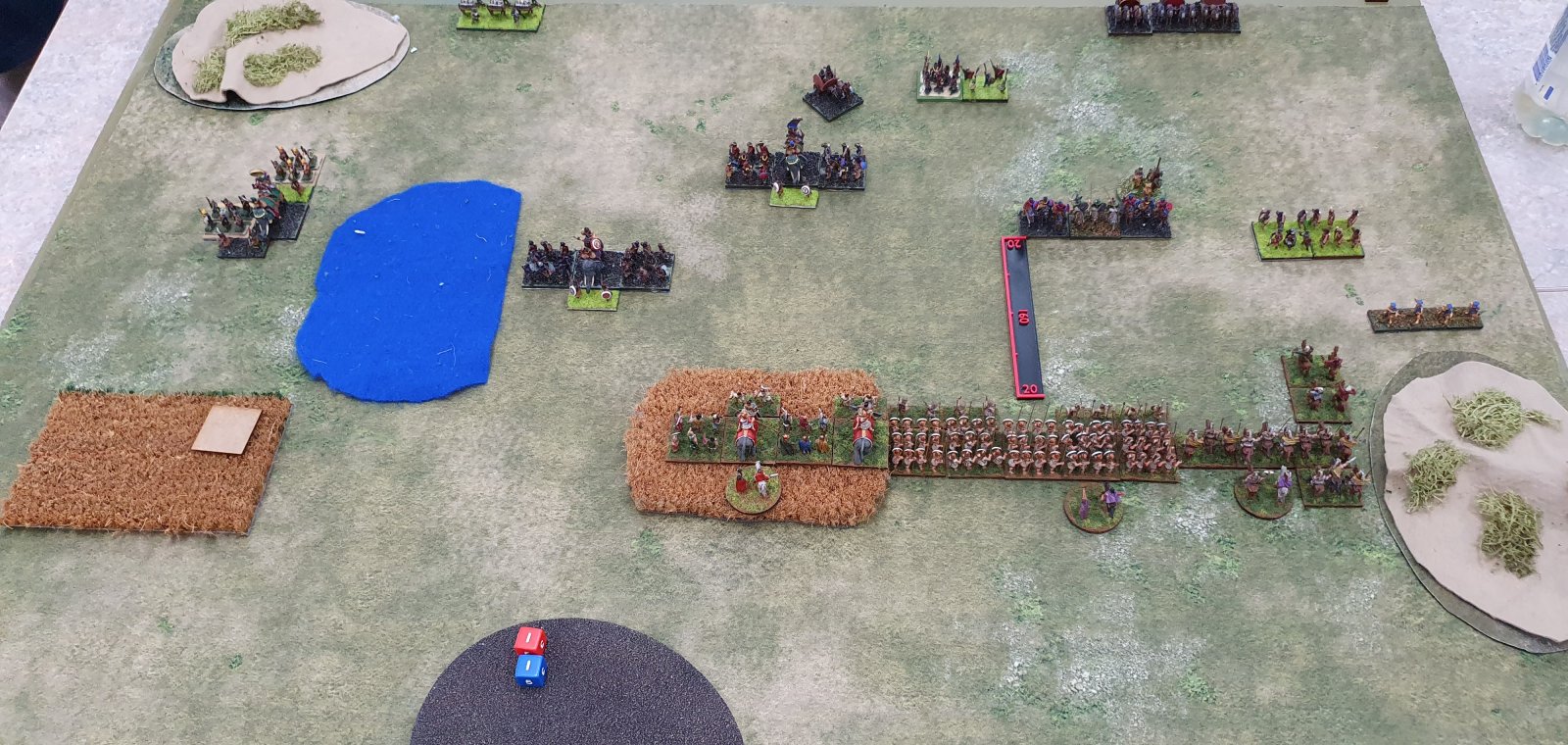
End of Alexandrian Turn One
In my first turn I moved up my battle line as far as I could (you can't get closer than 4UD in second move). There was a slight slide to the left to align the pikes with the edge of the brush, but it wasn't enough to let me expand my unit of Companion HC.
In retrospect, I maybe should have accepted the pikes going into the rough to make room for the heavy cavalry to expand.
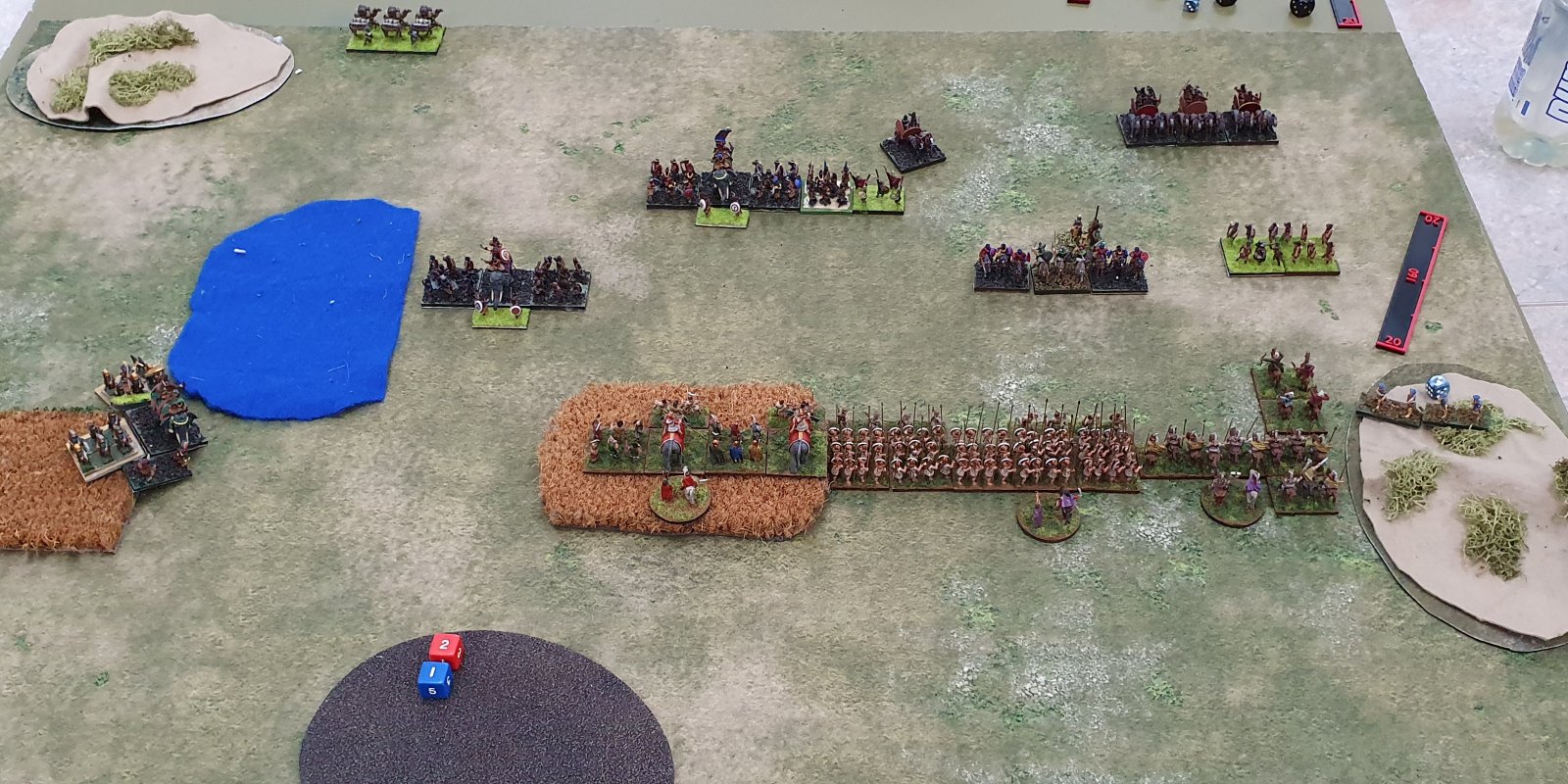
In their second turn, the Indians were pushing their flank elephant command behind my flank, but still a long way from my battle line. In the central command only the scythed chariot moved up. On my right flank he was pushing the skirmishers to the flank of my light horse, whilst for the rest of that command he moved up the levy / mixed unit group, slightly moved forward the medium cavalry to within 4 UD and moved up his heavy chariots.

End of Alexandrian Turn Two
Although I was at risk of being enveloped, I decided to move forward and try to win in the centre before being flanked. In hindsight a unit of LI in the ambush would have helped protect my flanks by stopping the double moves. However it would be at risk of being taken out by the Indian MI.
I moved my main battle line forward 2 UD (the most the pikes could move) and the Companions to ZOC the Medium Cavalry. My horse archers moved up to the front of the mediocre bowmen and exchanged fire. I put one hit on each unit of archers, and took one hit in return. Elsewhere my flank medium infantry and one unit of light infantry took hits from shooting.
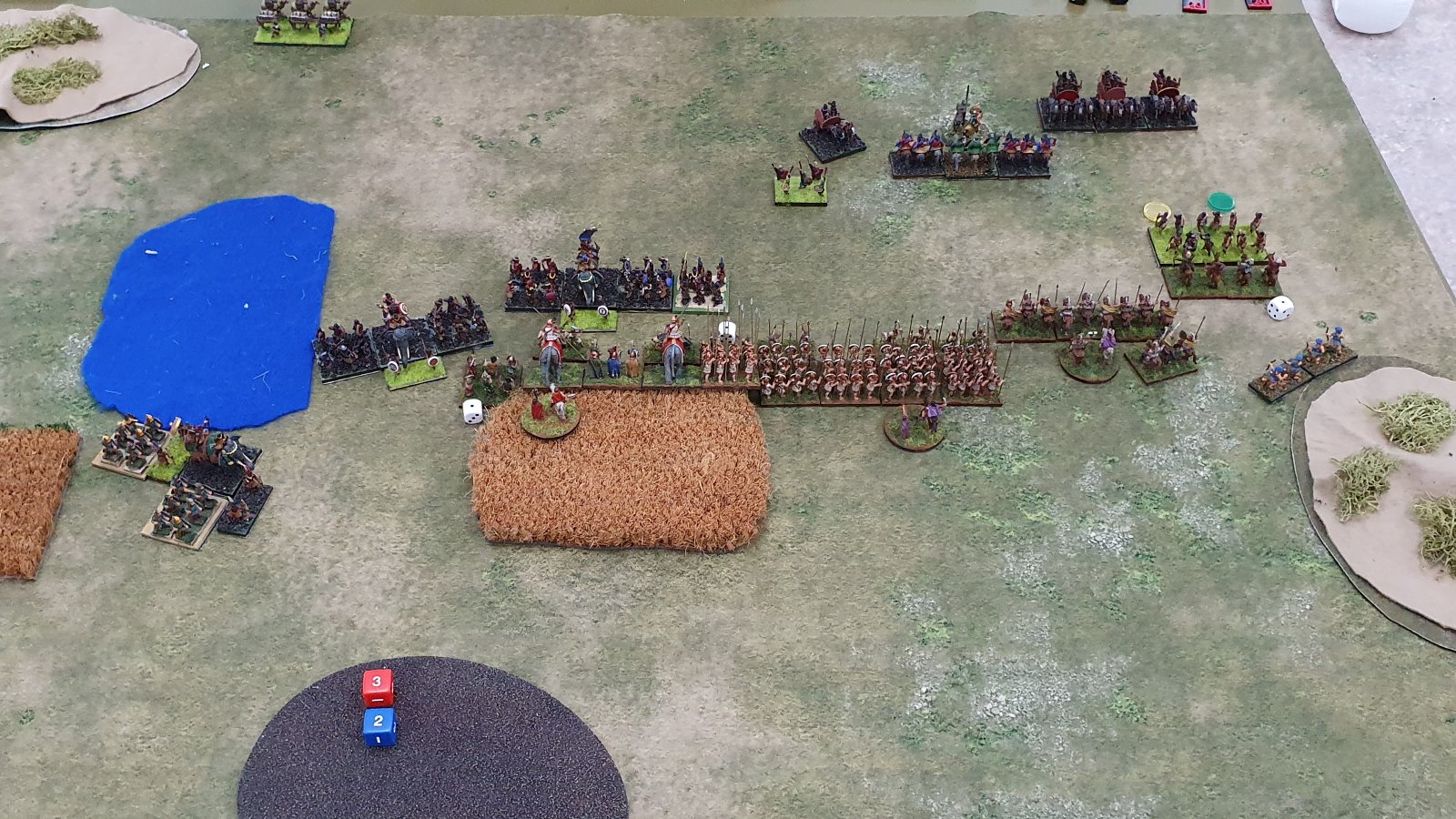
End of Indian Turn Three
The Indians were progressing their unit around my left flank. There was also another elephant group that moved up to ZOC my medium swordsmen at the end of my battle line. The other elephant group also moved up against my elephants. His medium cavalry evaded out of the ZOC. In the shooting battle between the archers and my horse archers, I inflicted another hit.
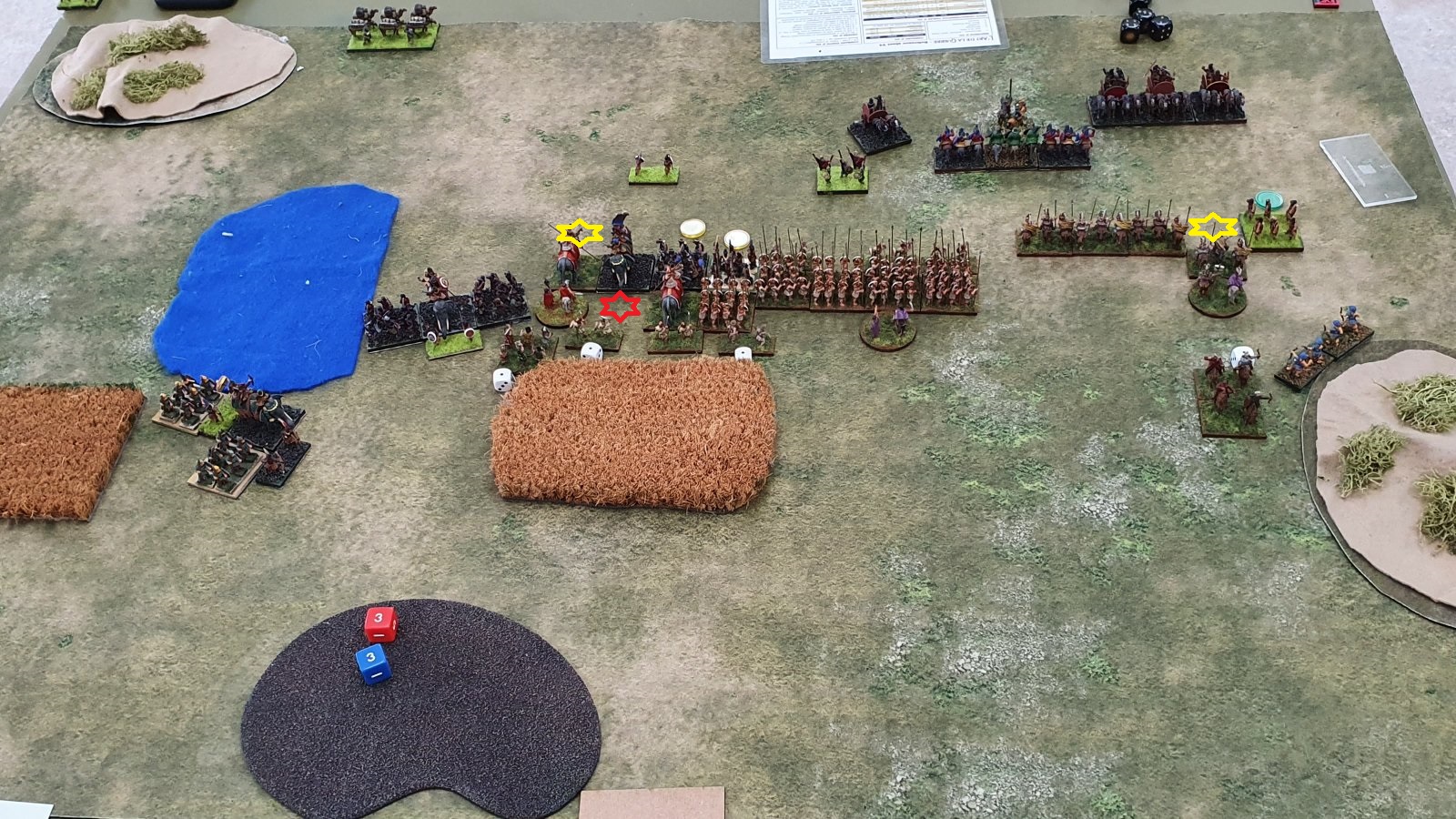
End of Alexandrian Turn Three
On the right flank my horse archers evaded out of the ZOC, just managing to fit between my Companions and the enemy skirmishers. I then charged one unit of Companions into the mediocre bow with the rest moving up in support.
In the elephant command the left MI swordsmen were ZOC'ed but the rest of the command charged. I won 3 combats (with one elephant destroying its opponent), but lost a MI swordsmen unit to the opposing elephant. In the center the pikes had moved up to charge the opposing infantry on the left and support the Companions on the right.
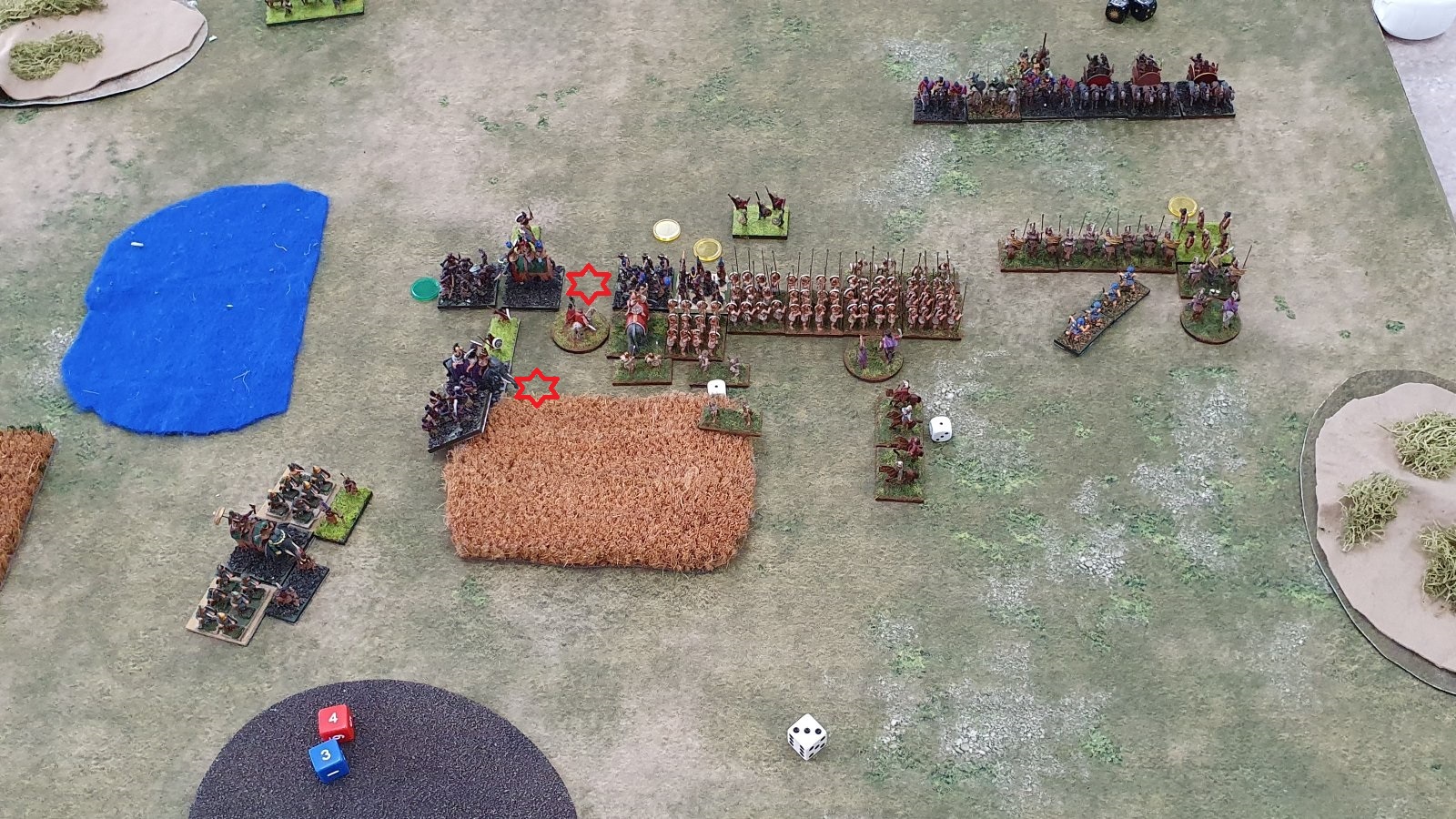
End of Indian Turn Four
In the Indian turn four, the scythed chariot moved up but was destroyed by
shooting. The flanking elephant command continued its advance behind my
lines. My elephant which had won in the last turn was attacked
in the flank and destroyed. I also lost my MI swordsmen who had been
holding back an elephant group. My remaining elephant and pikes drew their
combat. The Indian skirmishers on my right flank charged my light horse,
which evaded. The skirmishers ended up behind my Companions. In the
archers vs Companions melee, the surviving archers conformed to the Companions but only took 1
hit in the resulting combat.
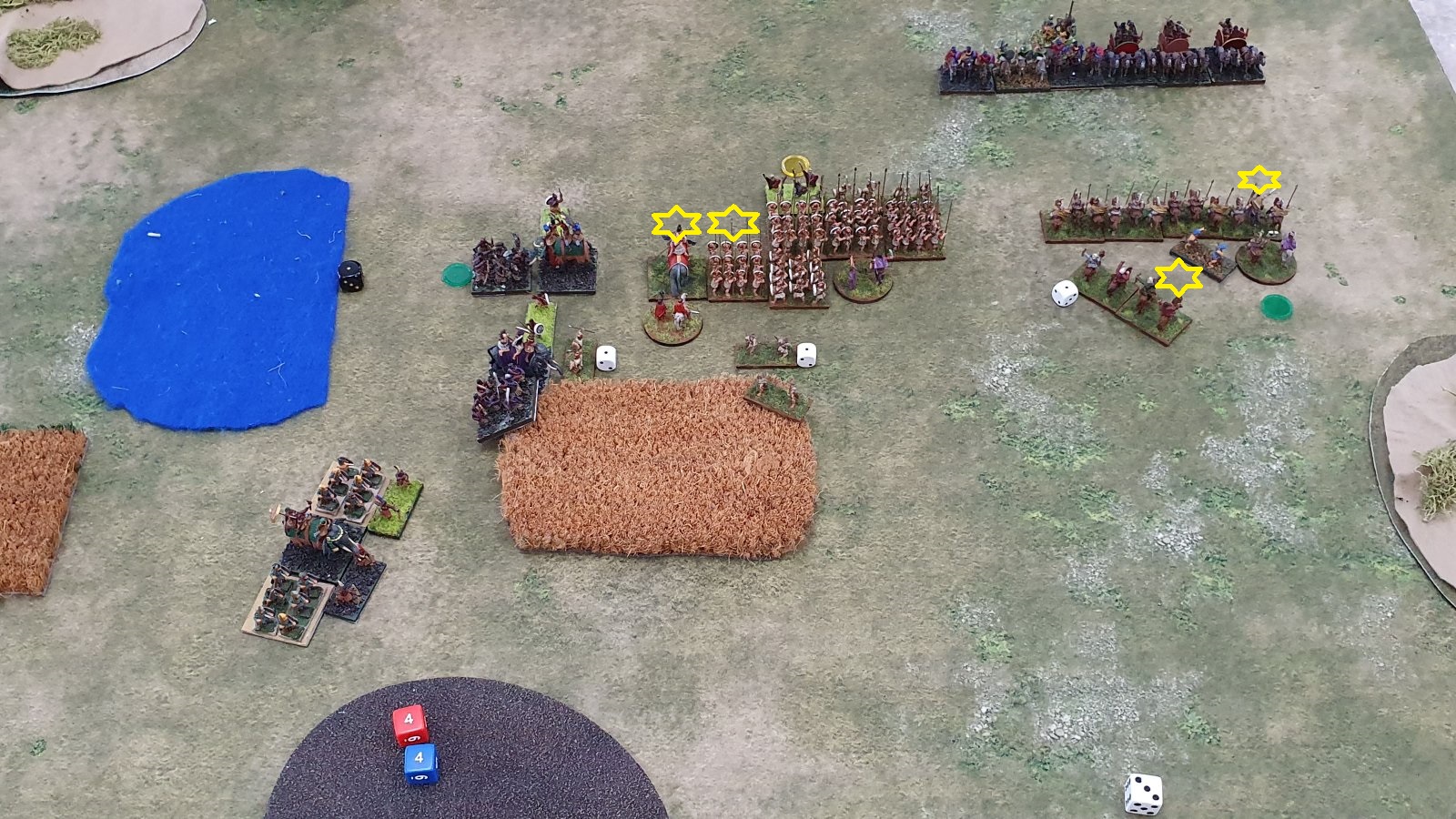
End of Alexandrian Turn Four
In my turn four my horse archers charged his skirmishers. One unit was able to evade but the other was destroyed in the resulting melee. My elephants and pikes won their combats and pursued 1 UD. My companions finished off the mediocre bows and was able to pursue to re-establish my cavalry group. Finally I could threaten the Indian mounted.
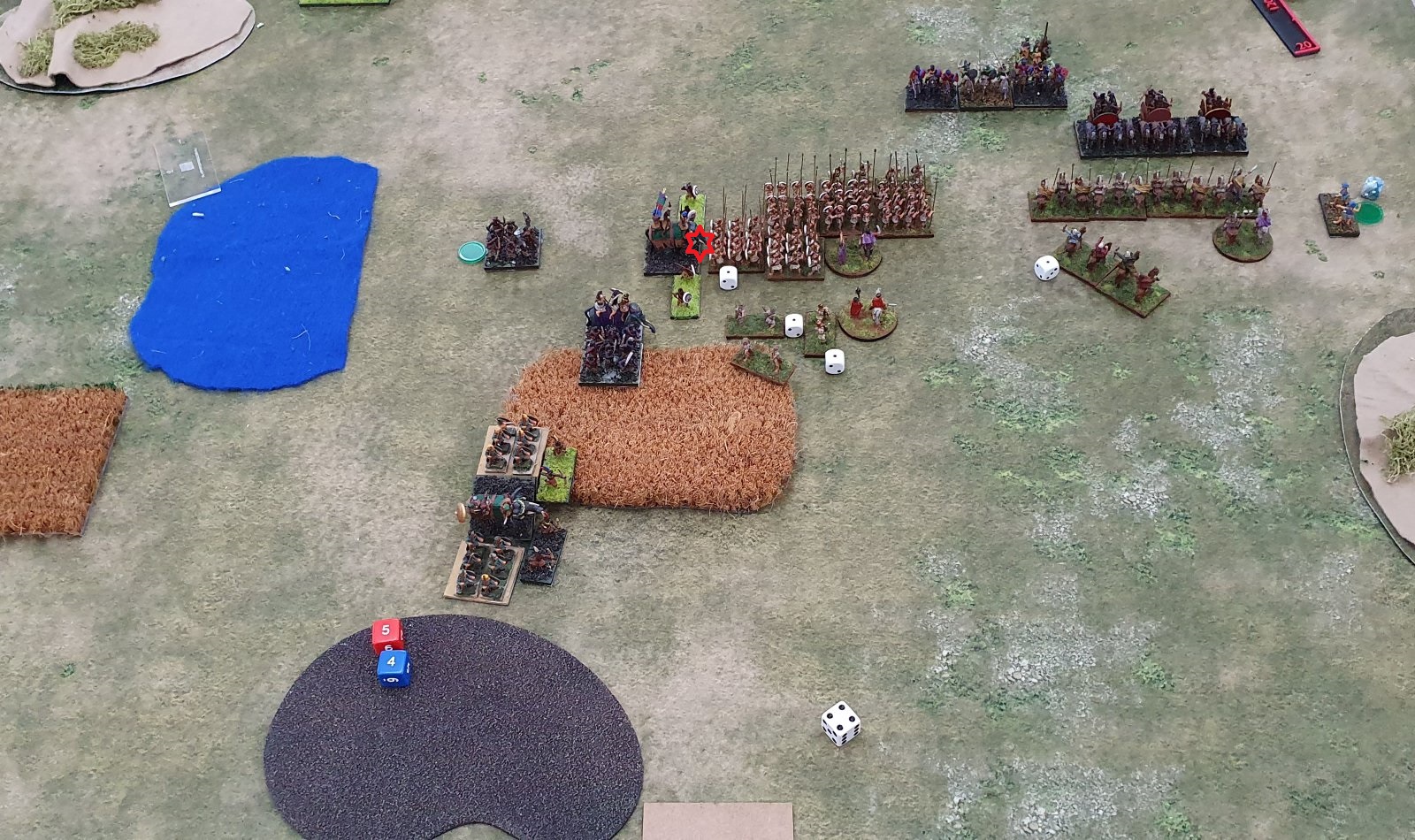
End of Indian Turn Five
Phillip moved his skirmishers from behind my Companions to on the flank. The heavy chariots moved up to ZOC my Companions, but his cavalry held back a little.
His elephant did a 180 degree turn and charged my elephant in the flank, routing it. My elephant had to orient to face and then rampaged through my pike inflicting a hit. His elephant pursued into contact.

End of Alexandrian Turn Five
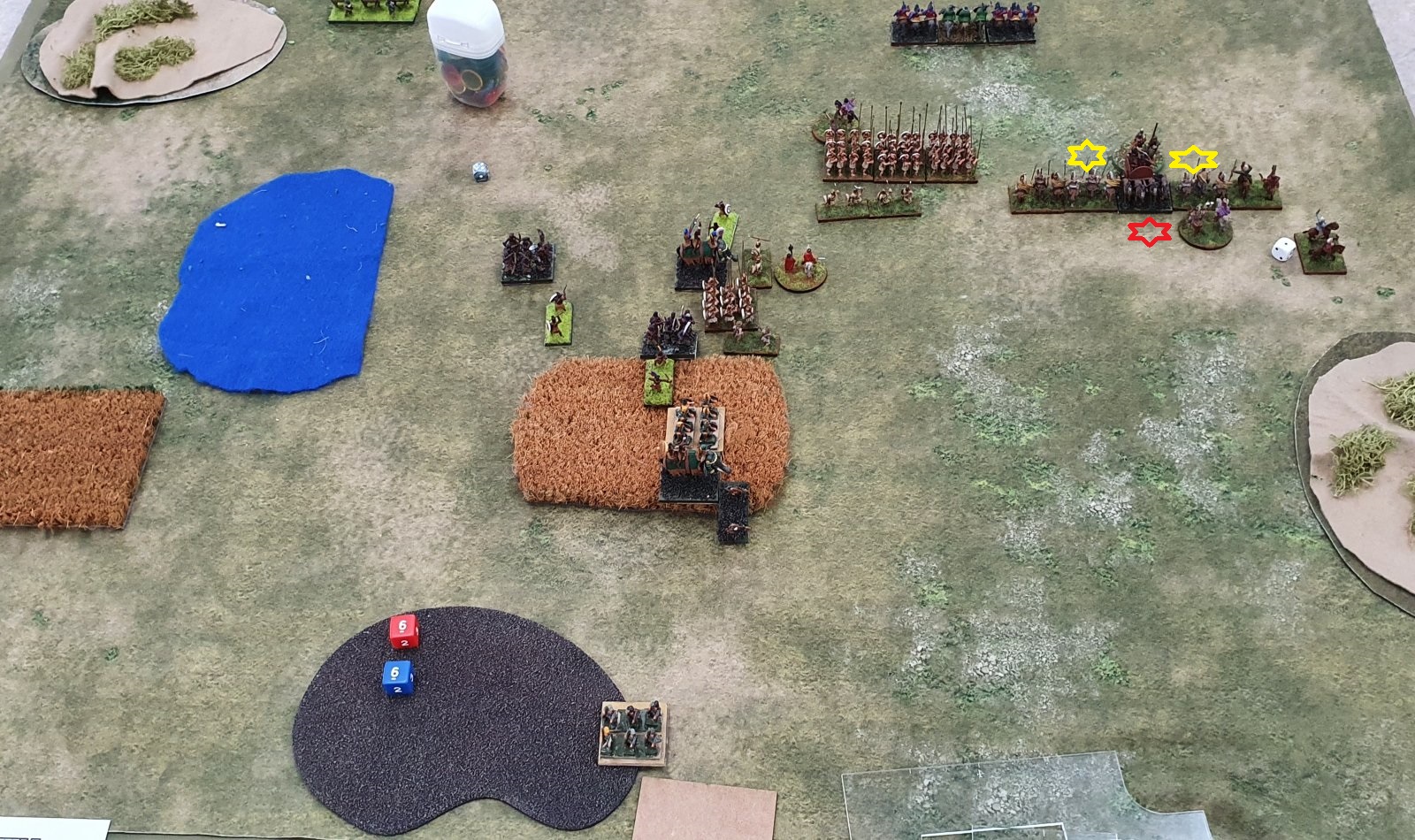
My Companions charged up against the Indian heavy chariots. One unit of light horse chased the enemy skirmishers off the board whilst the other tried to get into position to support the Companions but ended just shore. The combat resulted in 3 hits on the chariots and one on the Companions.
Three pike moved up to ZOC his cavalry. One unit of pike went to try and support the pike in contact with the elephant, but I don't think I was able to be into a supporting position and could only charge the skirmishers instead (otherwise we would have conformed in next photo - unless we made a mistake). The elephant routed the pike. In the photo the elephant has incorrectly pursued (it wasn't Indian turn) and Phillip is about to move it back.
At the end of turn 5, the Alexandrians had lost 15/22 cohesions points and the Indians had lost 18/25 cohesion points.
End of (Alexandrian) Turn Six
No photo for the Indian turn six. In his turn he moved his MI guard to just short of my camp. His cavalry evaded the pike ZOC.
In the Companions vs heavy chariots melee, I took out two units chariots for the lost of one unit of Companions.
The cohesion losses were
End of Indian turn six: Alexandrian lost 17/22, Indians
lost 19/25
End of Alexandrian turn six: Alexandrian lost 17/22, Indians lost 23/25
To save time, I suggested that for turn seven that we just see if the MI guardsmen could loot the camp. They moved into contact and rolled a 5 - a loss of 6 cohesion points and a win to the Indians as 23/22 vs 23/25.
I was surprised that Phillip chose mountain terrain, because I thought that the elephants and chariots would have preferred plains. However he explained after the game that because he had so much medium infantry he wanted as much terrain as possible.
The game effectively turned into a race to see if I could take out enough units to break his army before he turned my left flank.
I should have put a LI in the ambush on my left flank. This would have delayed the flanking elephant command by one or two turns, as without anything there he was able to move twice most turns. The ambush was probably just in command range of my left general, but that whole unit should have been deployed slightly to the left anyway. If it turned out that Phillip hadn't put anything on that flank I could have moved it up to threaten his camp.
I could have deployed my Pikes back and put my Companions in front of them to have enough room to deploy the 4 units in a line. I've had bad experiences in the past with putting cavalry in front of my battle line so didn't want to do that. I could have been facing elephants which would have been a disadvantageous match up, so probably better to have just deployed so that the Pikes would end up in the rough ground.
I should have used my Companions more aggressively, and taken the risk of taking shooting hits rather than worrying about have to screen them with the light horse. As it was the mediocre archers held things up for too long. The ten points of the Indian archers effectively delayed and tied up 48 points of Companions for several turns.
In terms of my army composition, I had too many (four) light infantry in the central command. If I moved one or two of these to my flank commands instead they could have been used in ambush. Alternatively I could have saved the points and increased the ratings of my generals. If I had been attacking rather than defending I may have been able to get into combat sooner.
Whilst the pikes are good, it was a definite handicap with them being unmanoeuvrable. I had considered having a HI Spear unit on the flank. This would either mean dropping two LI bow or one pike unit. Five pikes (with one elite) was a lot of points given that three of them never got into combat.
The other thing about my army is that it was fairly small as all the fighting units were expensive - 11 pts pike, 12 pts Companion HC, 13 pts elephants. When I next use the army I will have to think about whether I should drop some of these and bring in some Greek HI spear or cavalry.